Reliable fermentation is easier when dough is protected from temperature swings. The best compact bread proofing boxes create a controlled environment for sourdough, yeast breads, enriched dough, and even starter maintenance without taking over your kitchen.
We compare 10 options ranging from simple dough containers to heated, foldable proofers with timers, racks, and adjustable temperature controls. Use the guide below to match capacity and features to your baking routine.
Best 10 Compact Bread Proofing Boxes Picks for 2026
Best Overall
Folding Bread Proofer with Precise Controls

- 50–113°F range and 48-hour timer
- Folds flat with dual-position viewing window
- Insulated, easy-clean interior with metal rack
Best For: Home bakers needing flexible control and compact storage
Best for Small Kitchens
Compact 3-Sided Heating Proofer

- 50–130°F range with °C/°F toggle
- 24-hour timer with audible alarm
- Folds flat and weighs 2.5 pounds
Best For: Apartment, RV, and beginner bakers
Best Capacity
Folding Proofer with Humidity Monitoring

- 35-liter capacity for multiple items
- 68–131°F control with ±1°F precision
- Humidity gauge, water pan, and 99-hour timer
Best For: Multi-item fermentation and humidity-conscious bakers
Best Sensor Setup
Warming Box with Probe and Timer

- Probe monitors the proofing container temperature
- 50–113°F range and 48-hour auto-off timer
- Foldable, wipe-clean enclosure for one bowl
Best For: Single-bowl fermentation with direct temperature monitoring
Best Large-Capacity Proofer
Folding Temperature-Controlled Box

- 50–122°F range with ±1°F control
- Three-sided heating and 48-hour timer
- Folds down for easier storage
Best For: Multiple dough batches and varied fermentation projects
Best Slim-Folding Proofer
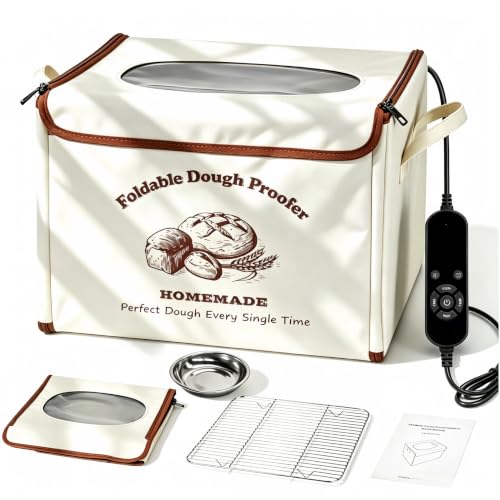
- Folds to just 45mm thick
- 70–122°F PID control with ±1°F precision
- Includes 1–24-hour timer and hygrometer
Best For: Small kitchens needing precise proofing in minimal storage space
Best with Extra Features
FOHERE 34L Folding Bread Proofer

- 32–113°F temperature control
- 0–48-hour timer
- 34L collapsible capacity
Best For: Home bakers needing flexible, spacious fermentation control
Best Heavy-Duty Pick
Foldable 24-Hour Dough Proofer

- 15.8 x 11.8 x 11.8-inch interior
- 50–113°F temperature range
- Folds for convenient storage
Best For: Space-conscious bakers making regular batches
Best Accessory Kit
Extra-Large Folding Dough Proofer
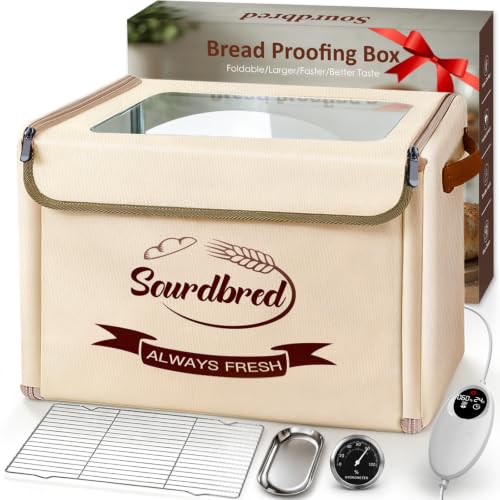
- Includes rack and water tray
- 1–48-hour timer
- Folds to about 2 inches thick
Best For: Bakers wanting accessories and large-batch flexibility
Best Overall – Folding Bread Proofer with Precise Controls
For bakers comparing compact bread proofing boxes, this foldable GIYUDOT model combines a useful 50–113°F range with a long 48-hour timer. Its insulated, 12-inch cube design is sized for a single bowl or fermentation jar and stores flat when not in use.
Best For: Home bakers who want flexible temperature control, long timed fermentation, and compact storage.
Pros:
- Adjustable 50–113°F temperature range with a 48-hour timer
- Foldable design with front- or top-view window placement
- Five-layer insulation, waterproof interior, and included stainless steel rack
- Automatic shutoff at 131°F and NTC temperature sensing
Cons:
- Its approximately 12-inch chamber is intended for one bowl or jar rather than large batches
- The 63-watt design has a lower maximum temperature than some alternatives
This is a well-rounded choice for compact kitchens, especially if you value storage convenience and a timer long enough for extended sourdough or fermentation projects.
Best for Small Kitchens – Compact 3-Sided Heating Proofer
This InnovifyHub model is one of the more space-conscious compact bread proofing boxes, folding flat for apartment, RV, or limited-counter use. It offers a 50–130°F range, 24-hour timer, and capacity for one large bowl, banneton, or several jars.
Best For: Apartment bakers and beginners who want a portable proofer for everyday small-batch fermentation.
Pros:
- Broad 50–130°F temperature range with Celsius/Fahrenheit switching
- Three-sided heat and NTC sensor support steady warming
- 24-hour timer with audible completion alarm
- Folds flat and weighs 2.5 pounds
Cons:
- The listed dimensions and capacity are best suited to small batches
- Only the folding box and controller are listed as included components
Choose this model when portability and straightforward controls matter more than maximum chamber size or extended timer capability.
Best Capacity – Folding Proofer with Humidity Monitoring
Among compact bread proofing boxes, the MQUPIN stands out for its larger 35-liter capacity and built-in humidity gauge. Its 68–131°F control range, 0–99-hour timer, water pan, and stainless steel bracket make it suited to more involved fermentation setups.
Best For: Bakers who need room for multiple items or want temperature and humidity information during fermentation.
Pros:
- Large 35-liter capacity in a foldable 15.7-by-11.8-by-11.8-inch format
- Temperature control from 68–131°F with ±1°F precision
- Built-in humidity gauge and included water pan
- Adjustable timer up to 99 hours with automatic heating stop
Cons:
- Its 68°F minimum may be too high for applications requiring cooler proofing
- Larger capacity requires more storage space than smaller folding models
This is the strongest fit for users who prioritize capacity and fermentation visibility, provided the higher minimum temperature suits their recipes.
Best Sensor Setup – Warming Box with Probe and Timer
This warming box offers a practical alternative among compact bread proofing boxes, with a 50–113°F range and a sensor that can be placed on the proofing container. The 48-hour auto-off timer and approximately 15.75-by-13-by-10-inch enclosure make it suitable for one standard proofing bowl.
Best For: Home bakers who want to monitor the actual proofing container temperature rather than only the surrounding air.
Pros:
- Probe-style NTC sensor monitors the proofing body’s temperature
- 50–113°F range supports bread, yogurt, kombucha, and other fermentation uses
- 0–48-hour timer with automatic shutoff
- Foldable vinyl enclosure is easy to wipe clean
Cons:
- The open-top design may provide less enclosure than zipper or windowed models
- Capacity is intended for one standard proofing bowl
- Its 45-watt heater may take longer to reach the selected temperature than higher-wattage options
Its main advantage is targeted temperature monitoring, making it a sensible pick for bakers who want a simple, adjustable setup centered on one bowl.
Best Stackable Container – 5-Quart Dough Proofing Tray
For bakers looking for compact bread proofing boxes without adding an electric appliance, this 5-quart container offers a simple, space-conscious solution. Its rectangular footprint, lid, volume markings, and stackable design make it practical for everyday sourdough, bread, and pizza dough preparation.
Best For: Home bakers who want one container for mixing, folding, proofing, and refrigerated dough storage.
Pros:
- Holds up to 6.6 pounds of dough or up to six dough balls.
- Translucent walls and volume markings make dough growth easy to monitor.
- Stackable design works in refrigerators and compatible proofing boxes.
- BPA-free polypropylene is designed to resist stains, odors, and sticky residue.
Cons:
- It does not provide active temperature control or heating.
- The 5-quart capacity may be limiting for especially large batches.
This is a strong choice when compact storage and straightforward dough handling matter more than automated temperature management. The included lid helps retain moisture, while the wide base supports stretch-and-fold techniques.
Best Large-Capacity Proofer – Folding Temperature-Controlled Box
This folding model is one of the more capable compact bread proofing boxes for bakers who need controlled warmth but limited permanent counter space. Its adjustable 50–122°F range, three-sided heating, timer, and foldable construction support repeatable proofing across different seasons.
Best For: Home bakers proofing multiple batches who want active temperature control and convenient storage.
Pros:
- Provides adjustable 50–122°F temperatures with stated ±1°F precision.
- Three-sided heating is designed for faster, more even warmth.
- Folds for storage while offering approximately 15.7 × 11.8 × 11.8 inches of interior space when open.
- Viewing window, waterproof interior, metal rack, and automatic shut-off add convenience.
Cons:
- Its unfolded footprint is larger than a simple proofing container.
- The listed safety shut-off is four hours, which may require resetting during longer proofs.
Choose this proofer if you want a balance between large working capacity and fold-away storage. It also supports yogurt, kombucha, and chocolate projects, making the temperature control useful beyond bread dough.
Best Slim-Folding Proofer – PID-Controlled Dough Box
For kitchens where storage depth is especially important, this compact bread proofing box folds to just 45mm thick. PID temperature control, a 1–24-hour timer, and included humidity-related accessories give bakers a more controlled environment for sourdough, pizza dough, and other fermentation projects.
Best For: Space-conscious bakers who want precise warming, flexible timing, and a very thin folded profile.
Pros:
- Adjusts from 70–122°F with stated ±1°F PID precision.
- 1–24-hour timer accommodates both shorter proofs and extended fermentation.
- Folds to approximately 45mm thick for efficient storage.
- Includes a stainless steel bowl, hygrometer, stand, and overheat protection.
Cons:
- Its temperature range begins at 70°F, so it offers less low-temperature flexibility than models starting at 50°F.
- The interior capacity is listed at 28 liters, smaller than the 36-liter alternative.
This model is a practical fit when a slim storage profile is a priority. The timer and PID control offer useful precision, while the food-grade waterproof interior and wipe-clean care instructions simplify routine use.
Best with Extra Features – FOHERE 34L Folding Bread Proofer
For bakers comparing compact bread proofing boxes, the FOHERE combines a foldable 34-liter design with adjustable temperature control and an extended timer. Its convection heating, insulation, and clear viewing window are designed to support consistent fermentation without taking up permanent counter space.
Best For: Home bakers who want a spacious, foldable proofer for sourdough and other fermentation projects.
Pros:
- 32–113°F temperature range supports slow and warmer fermentation.
- 0–48-hour timer suits long-ferment sourdough recipes.
- 34-liter capacity holds a mixing bowl and four small jars simultaneously.
- Waterproof liner and clear window simplify monitoring and cleanup.
Cons:
- Hand-wash care is required.
- The relatively large capacity may be more than needed for occasional small batches.
The FOHERE is a strong all-around choice when timer flexibility and multi-use capacity matter. It folds for storage while still accommodating bread dough, yogurt, kombucha, and other fermentation projects.
Best Heavy-Duty Pick – Foldable 24-Hour Dough Proofer
This foldable model is a practical option among compact bread proofing boxes, offering a roomy interior that collapses for storage. Its digital controls, NTC sensor, and transparent window help maintain and monitor a controlled fermentation environment.
Best For: Home bakers who need batch-friendly capacity but have limited storage space.
Pros:
- 15.8 x 11.8 x 11.8-inch interior accommodates multiple dough bowls or yogurt containers.
- Adjustable 50–113°F temperature range and timer up to 24 hours.
- Layered insulation and an NTC sensor help retain and monitor warmth.
- Unfold-and-plug setup requires no assembly.
Cons:
- The timer is limited to 24 hours, shorter than some competing models.
- Its minimum temperature of 50°F is less suited to colder slow-fermentation settings.
This proofer balances useful interior space with easy storage. It is particularly appealing for everyday dough, yogurt, kombucha, and similar projects when a 24-hour cycle is sufficient.
Best Accessory Kit – Extra-Large Folding Dough Proofer
For shoppers seeking compact bread proofing boxes with useful accessories, this extra-large folding proofer includes a metal rack and water tray. Its three heating areas, five-layer insulation, and 1–48-hour timer are designed for stable warming while the box folds to about two inches thick.
Best For: Bakers who want an accessory-rich proofer for large bowls, starter warming, and humid fermentation.
Pros:
- Includes a metal rack, water tray, controller, and user guide.
- 1–48-hour timer supports both short and extended fermentation.
- Extra-large viewing window makes it easier to observe dough without opening the box.
- Folds to approximately two inches thick and has two carrying handles.
Cons:
- Its 66–108°F range is narrower than some alternatives.
- The extra-large format may require more active setup and storage space when unfolded.
- Hand-wash care is specified.
The included rack and water tray make this a versatile setup for bakers who want humidity control without sourcing extra pieces. Its slim folded profile is useful for storage, while the larger interior handles a big bowl and multiple bottles.
How We Picked These Compact Bread Proofing Boxes
We focused on the features that most directly affect proofing consistency and daily usability: temperature range, adjustment accuracy, timer length, interior capacity, insulation, rack design, sensor placement, cleanup, and storage. The selection includes heated folding proofers as well as passive dough containers, since different bakers need different levels of control.
Temperature claims and capacity should be treated as manufacturer specifications. Actual performance can vary with room temperature, dough mass, container placement, and whether the lid or door is opened during fermentation.
Quick Comparison
| Type | Best For | Features to Prioritize |
|---|---|---|
| Heated folding proofer | Frequent bread and sourdough baking | Wide temperature range, stable sensor, timer, foldable storage |
| Rack-style dough proofer | Multiple containers or loaves | Interior height, metal rack, even heating, door access |
| Large-capacity model | Big batches and family baking | Weight capacity, usable floor space, ventilation |
| Passive dough container | Simple rising and refrigerator fermentation | Airtight lid, markings, food-safe materials, easy cleaning |
Key Buying Factors for Compact Bread Proofing Boxes
Temperature Control
Look for a range that covers cool fermentation as well as warm proofing. Adjustable controls are more useful than a single heat setting, particularly for sourdough, which may require different temperatures depending on the recipe and schedule. A sensor or PID-style controller can help reduce temperature swings, but placement and calibration still matter.
Capacity and Interior Layout
Check usable interior dimensions rather than relying only on a stated capacity. A compact box should fit your preferred bowl, banneton, loaf pan, or dough tray without touching the heating surface. Racks add flexibility, while large containers are better for high-hydration dough or bulk fermentation.
Timer and Storage Design
A timer is useful when you need the proofer to stop heating after a set period. Longer 24- or 48-hour timers suit overnight schedules and sourdough routines. Folding panels are valuable in small kitchens, but confirm that the assembled unit feels stable and that repeated folding will not strain the controls or power connection.
Cleaning and Safety
Choose smooth, wipeable interiors and keep dough, condensation, and spills away from electrical components. A passive container should use food-safe materials and a secure lid. Heated models should sit on a stable, heat-resistant surface with adequate clearance around vents.
Who Should Buy Which Compact Bread Proofing Boxes?
Choose a heated folding model if you bake regularly, your kitchen temperature changes significantly, or you want repeatable proofing for sourdough and yeast dough. These are the most versatile Compact Bread Proofing Boxes.
Choose a rack-equipped model if you proof multiple small containers, use loaf pans, or want more separation between dough and the heating area.
Choose an extra-large model if you regularly make double batches or need room for large bowls. Measure your storage area first, because greater capacity usually means a larger footprint when assembled.
Choose a passive dough container if you mainly need a covered vessel for bulk fermentation and do not require active temperature control. It is the simplest and often most space-efficient option, but it cannot compensate for a cold room.