The best tomato presses separate skins, seeds, and cores from ripe tomatoes quickly, giving you smoother sauce with less prep work. The right choice depends on how often you process tomatoes, how much counter space you have, and whether you prefer manual control or electric speed.
We compared manual, clamp-on, countertop, and commercial-style tomato presses to help you find a practical match for small batches, family canning, or serious harvest-season processing.
Best 10 Tomato Presses Picks for 2026
Best Versatile Hand-Crank Pick
Johnny Model 250 Food Strainer

- Handles sauces, purees, juices, and more
- Includes 1.3mm apple/tomato screen
- Clamp fits countertops 3/4–2-1/8 inches thick
Best For: Multi-purpose home food preparation
Best Traditional Sauce Strainer
- Listed 3-quart capacity
- Separates juice and pulp in one operation
- Includes fine mesh screen and spiral
Best For: Manual sauce and puree processing
Best High-Volume Electric Option

- Processes up to 330 pounds per hour
- Automatically separates puree, skins, and seeds
- Uses a 1/4 HP corded motor
Best For: Large tomato harvests and batch processing
Best Compact Small-Batch Press
- 3-cup capacity for smaller batches
- 2mm stainless steel screen
- Auger helps reduce jamming and leaking
Best For: Occasional small-batch sauces and jams
Simple Kitchen Strainer

- Separates skins and seeds
- Suction-cup base for stability
- Includes stainless steel pusher
Best For: Small-batch sauces, salsa, and puree
Best for Everyday Use
Weston Deluxe Electric Tomato Strainer

- 250-watt motor with reverse
- One-gallon hopper for batches
- Three stainless steel screens
Best For: Large-batch preserving and sauces
Durable Manual Workhorse
Weston Stainless Steel Tomato Strainer
- Stainless steel construction
- One-gallon hopper
- Suction base and C-clamp mounts
Best For: Large manual batches at home or outdoors
Best Manual Pick
- Manual press for sauce, salsa, juice, and purée
- 2.25-quart hopper with stainless steel mesh
- Suction base stabilizes it on smooth counters
Best For: Home canning and small-to-medium batches
Best High-Output Electric

- Processes up to 330 pounds per hour
- Dual-channel system separates seeds and skins
- 304 stainless steel with 5-year warranty
Best For: Large home-canning batches and commercial kitchens
Best Commercial-Style Value
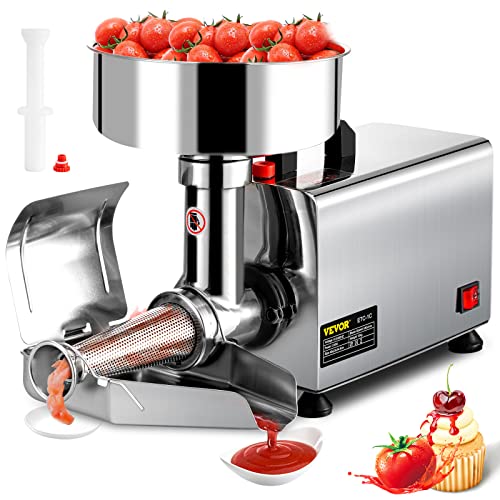
- 370W pure copper motor for electric milling
- 9-inch funnel and adjustable discharge trough
- 304 stainless steel food-contact components
Best For: Frequent sauce making and larger batches
Best Versatile Hand-Crank Pick – Johnny Model 250 Food Strainer
If you want tomato presses that can handle more than one type of sauce, the Johnny Model 250 is a flexible manual option. It separates skins and seeds from produce for sauces, purees, juices, jams, soups, and baby food, and includes a 1.3mm apple/tomato screen.
Best For: Home cooks who want one countertop strainer for tomato sauce and other fruit or vegetable preparations.
Pros:
- Includes an apple/tomato screen, standard spiral, and instruction manual.
- Clamp mounts to countertops from 3/4 to 2-1/8 inches thick.
- Can be used with an optional electric motor sold separately.
- Cast aluminum body, stainless steel screens, and BPA-free plastic components.
Cons:
- The electric motor is not included.
- Additional salsa, pumpkin, and berry screens cost extra.
Its broad food-preparation range and secure clamp make it a practical choice for small-batch preserving, especially if you prefer manual control but may want motor assistance later.
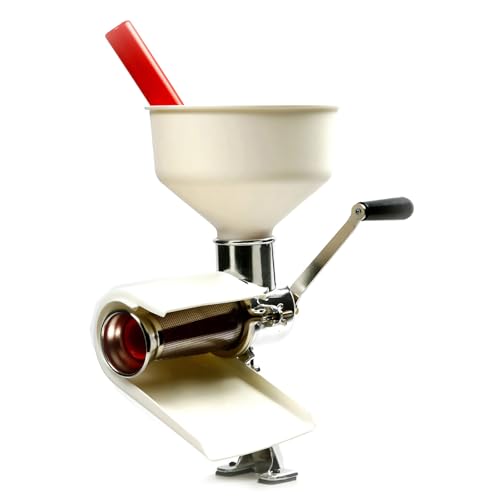
Best Traditional Sauce Strainer – Norpro 1951 Sauce Master
The Norpro 1951 Sauce Master is one of the straightforward tomato presses for separating juice and pulp in a single manual operation. Its chrome-plated steel screen is designed for vegetables, fruits, and purees, with a stated 3-quart capacity.
Best For: Cooks seeking a traditional manual strainer with a relatively large listed capacity for sauce and puree preparation.
Pros:
- Separates juice and pulp as food is forced through the screen.
- Includes a standard fine mesh screen and standard spiral.
- Comes with a recipe and instruction booklet.
- Optional berry, pumpkin, and salsa screens are available separately.
Cons:
- Extra screens are sold separately.
- Its listed dimensions are relatively substantial for a manual countertop appliance.
With its fine mesh screen and 3-quart capacity, the Sauce Master suits users who want a dedicated, no-electricity approach to processing tomatoes, fruits, and vegetables.
Best High-Volume Electric Option – OMRA Spremy Model 850
For large harvests, the OMRA Spremy 850 stands apart from manual tomato presses with its corded 1/4 HP motor. It automatically separates tomato puree from skins and seeds and is rated for production up to 330 pounds of tomatoes per hour.
Best For: Users processing substantial quantities of fresh or cooked tomatoes who want powered operation.
Pros:
- Electric system automatically separates puree, seeds, and skins.
- Rated for up to 330 pounds, or 150 kg, of tomatoes per hour.
- Features a die-cast metal housing and stainless steel hopper.
- Food-grade nylon auger rotates at 110 RPM with a cooling-fan-equipped motor.
Cons:
- Requires a corded electrical connection and is listed at 220 volts.
- Its tomato-focused, high-capacity design may be more than needed for small batches.
The OMRA is the strongest fit here for serious seasonal processing, provided your electrical setup supports its 220-volt power requirement.
Best Compact Small-Batch Press – Weston Fruit & Tomato Press
The Weston Fruit & Tomato Press is a compact choice among tomato presses, with a 3-cup capacity for smaller quantities of sauce, juice, and jam. Its manual handle drives an auger that separates seeds and skins from pulp through a 2mm stainless steel screen.
Best For: Home cooks making small batches who want a compact manual press rather than a high-capacity machine.
Pros:
- 3-cup capacity suits small-batch preparation.
- Stainless steel screen has 2mm holes.
- Innovative auger is designed to help prevent jamming and leaking.
- Includes a stomper for feeding produce.
Cons:
- Small capacity is less suited to large harvests.
- Manual winding requires hands-on operation.
Its compact size and included stomper make this Weston model a sensible fit for occasional sauces, jams, juices, or baby food when you do not need industrial-scale throughput.
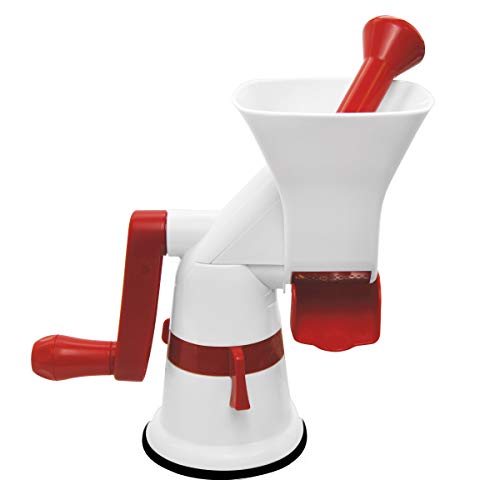
Simple Kitchen Strainer – Manual Tomato Press
This manual tomato press is a practical choice for cooks who want fresh juice, puree, or salsa without peeling, coring, or deseeding tomatoes first. Its suction-cup base helps keep the food mill steady during countertop use.
Best For: Home cooks who want a compact, manual option for small-batch sauces, salsa, and tomato puree.
Pros:
- Separates skins and seeds while juice flows into the tray.
- Suction mount helps stabilize the press during use.
- Includes a stainless steel pusher and is designed for easy cleaning.
- Can also be used for straining, juicing, and pureeing.
Cons:
- Manual operation requires more hands-on effort than an electric model.
- Plastic construction may be less substantial than stainless steel alternatives.
This is a straightforward tomato press for everyday kitchen projects, especially if you value simple operation and do not need the batch-processing capacity of a larger electric strainer.
Best for Everyday Use – Weston Deluxe Electric Tomato Strainer
For larger preserving projects, this electric tomato press combines a 250-watt motor with a one-gallon hopper. It is built to remove skins and separate seeds from tomatoes and other soft produce without coring, making it useful for sauces, jams, jellies, and salsa.
Best For: Gardeners and home preservers processing large batches of tomatoes or other soft fruits and vegetables.
Pros:
- 250-watt motor offers two speeds, including reverse to help prevent jamming.
- One-gallon hopper supports larger batches.
- Includes 1.5mm, 3mm, and 6mm stainless steel screens for different textures.
- Stomper helps guide food safely into the hopper.
Cons:
- Requires access to a 120-volt power source.
- Larger 14-by-12-by-17-inch footprint needs dedicated storage space.
- Plastic and stainless steel construction may require more cleanup than a simpler manual press.
This Weston model is the strongest fit for frequent preserving sessions. Its multiple screens add versatility, while the electric motor reduces the effort required for processing substantial harvests.
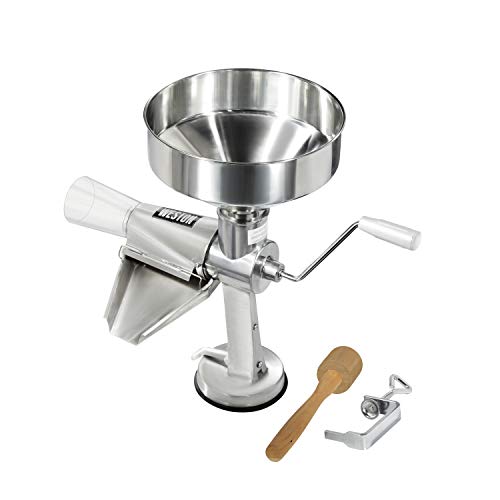
Durable Manual Workhorse – Weston Stainless Steel Tomato Strainer
This stainless steel tomato press offers manual processing with a one-gallon hopper and a dual-mount system. The suction-cup base and C-clamp give you flexibility to secure it on different flat surfaces, including a kitchen counter or garden table.
Best For: Cooks who want a sturdy manual tomato press for larger batches and flexible countertop or outdoor use.
Pros:
- Stainless steel hopper, handle, splash guard, and chute support durable food processing.
- One-gallon hopper is suited to larger batches of tomatoes and other produce.
- Dual mounting system works with suction or a C-clamp.
- Includes a stomper and 1.5mm screen for tomatoes and apples.
Cons:
- Manual handle operation requires physical effort.
- Only the 1.5mm screen is included; additional screens are sold separately.
- Its stainless steel build may be heavier than compact plastic presses.
This model balances batch capacity with manual control. It is a good choice when mounting flexibility and stainless steel components matter more than electric convenience or included screen variety.
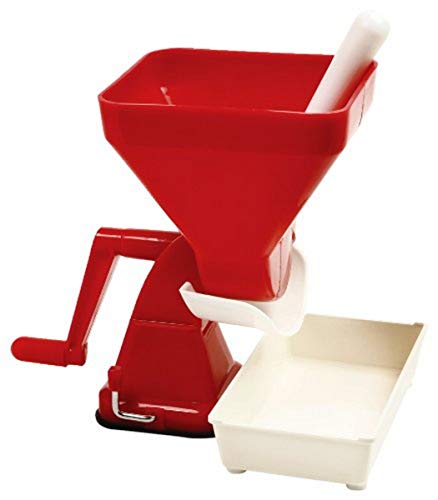
Best Manual Pick – Norpro Jumbo Tomato Strainer
For home cooks comparing tomato presses, the Norpro Manual Jumbo Tomato Strainer is a practical choice for turning fresh tomatoes into sauce, salsa, juice, purée, or paste. Its hand-crank design avoids electricity, while the stainless steel mesh separates seeds, skins, and stems.
Best For: Home canning, small-to-medium batches, and cooks who prefer a manual press.
Pros:
- Separates seeds, skins, and stems automatically through a stainless steel mesh screen.
- Large 2.25-quart hopper and 1.25-quart receiving tray support batch processing.
- Suction base helps keep the press stable on smooth countertops.
- Disassembles quickly and includes a pestle, instructions, and starter recipes.
Cons:
- Manual cranking requires more physical effort than an electric model.
- The suction base is intended for smooth surfaces.
This Norpro is a useful tomato press for traditional sauce-making and occasional canning. Choose it when control, simplicity, and a compact manual setup matter more than maximum throughput.
Best High-Output Electric – ARINOO 450W Tomato Strainer
Among electric tomato presses, this ARINOO machine is designed for fast, high-volume processing. Its 450W pure copper motor and dual-channel straining system separate skins and seeds from pulp, making it suitable for home canning as well as restaurant, farm, and commercial kitchen use.
Best For: Large batches and users who want electric processing with commercial-style capacity.
Pros:
- Rated to process up to 330 pounds per hour.
- Dual-channel design strains seeds and skins without an additional filter.
- Food-grade 304 stainless steel construction resists rust.
- Includes a food pusher, detachable parts, and a 5-year manufacturer warranty.
Cons:
- At 20.9 pounds, it is substantially heavier than the manual Norpro.
- Requires a corded power source and hand washing.
- Continuous operation should be limited to 15 minutes before a 5-minute cooldown.
This ARINOO press makes the most sense when speed and volume are priorities. Its electric motor and stainless steel build offer a capable setup for frequent sauce, jam, and purée production, provided you have room and access to an outlet.
Best Commercial-Style Value – VBENLEM 370W Tomato Strainer
The VBENLEM 370W is one of the more substantial electric tomato presses for buyers who want a commercial-style machine without manual cranking. It combines a pure copper motor with stainless steel food-contact parts, a wide funnel, and an adjustable discharge trough for processing tomatoes and other fruits into sauces and jams.
Best For: Frequent sauce making, larger batches, and users who value adjustable feeding and discharge.
Pros:
- 370W pure copper motor supports electric milling.
- Food-contact components use 304 stainless steel and are easy to disassemble.
- 9-inch funnel accommodates generous fruit loading.
- Adjustable trough and brace help guide sauce and reduce splashing.
Cons:
- At 22 pounds, it is heavy for a countertop appliance.
- Its 110V electric design requires a suitable outlet.
- The supplied notes do not specify a warranty.
For shoppers seeking a sturdy electric tomato press for recurring sauce or jam production, the VBENLEM offers useful capacity-focused features. Its weight and commercial-grade format are best suited to a dedicated workspace rather than occasional, easily stored use.
How We Picked the Best Tomato Presses
We focused on the features that matter during real sauce-making sessions: pressing capacity, power or leverage, hopper and collection design, separation performance, cleanup, durability, and storage. The lineup includes compact manual models for occasional use, electric presses for faster batches, and higher-capacity machines suited to gardeners and home canners with substantial harvests.
Because product specifications and included accessories can vary, confirm the current materials, voltage, replacement parts, and capacity before ordering. Electric models should also be matched to the outlet and workspace where you plan to use them.
Quick Comparison
- Best for occasional batches: Compact manual and clamp-mounted presses are affordable, easy to store, and require no outlet.
- Best for regular home canning: Electric countertop models reduce hand effort and process tomatoes more consistently.
- Best for large harvests: Heavy-duty stainless-steel or commercial-style machines offer larger hoppers and faster throughput.
- Best for flexibility: Sauce makers with interchangeable screens or accessories can handle other soft fruits and vegetables.
Key Buying Factors for Tomato Presses
Manual or Electric Operation
Manual presses are quieter, simpler, and generally easier to store, but they require steady cranking and can become tiring during large batches. Electric Tomato Presses are faster and more convenient when processing several baskets of produce, though they cost more and need a suitable workspace.
Capacity and Throughput
Look at hopper size, collection capacity, and stated processing rate rather than relying on motor wattage alone. A small press can be ideal for dinner-sized batches, while a large hopper and continuous-feed design are more useful for canning days.
Construction and Stability
Stainless steel components are valuable for frequent use and easier sanitation. For manual models, a strong clamp or stable base prevents movement. Electric models should have a secure footprint, durable auger components, and controls that are easy to reach while feeding tomatoes.
Screen Design and Cleanup
The screen determines how effectively the machine separates skins and seeds and may affect sauce texture. Removable screens, strainers, and augers simplify cleanup. Check whether parts are dishwasher-safe and whether replacement screens are available.
Who Should Buy Which Tomato Presses?
Choose a compact manual press if you make occasional fresh sauce, have limited storage, or want a low-cost tool that works without electricity.
Choose a larger manual model if you prefer hands-on control but process more produce than a small clamp-on unit can comfortably handle.
Choose an electric countertop press if you make sauce or juice regularly and want to reduce cranking, peeling, and seed removal.
Choose a commercial-grade stainless-steel model if you process large harvests, prioritize durability, or need higher throughput for repeated canning sessions. Before buying, measure your counter space and verify voltage, included accessories, and cleaning requirements.