Manual grain mills give you a practical way to turn wheat, corn, oats, rice, and other dry grains into fresh flour without relying on electricity. The right model can also support homesteading, emergency preparedness, and small-batch kitchen projects.
These 10 picks range from compact countertop grinders to heavy-duty cast-iron mills. Compare capacity, burr or plate construction, adjustment control, crank effort, and intended ingredients before choosing.
Best 10 Manual Grain Mills Picks for 2026
Most Versatile

- Grinds grains, nuts, seeds, spices, and oily foods
- Includes stone and stainless steel burrs
- Produces up to 1.25 cups of flour per minute
Best For: Home cooks seeking a versatile hand mill for varied ingredients
Best Traditional Design
Victoria Manual Cast Iron Grain Mill

- Heavy-duty cast-iron construction
- Adjustable coarse-to-fine grinding
- Handles grains, coffee, seeds, nuts, and spices
Best For: Coarse-to-medium grinding and traditional kitchen use
Best Lifetime Investment
Country Living Hand Grain Mill

- Solid cast aircraft-aluminum construction
- Adjusts from cracked grain to cake flour
- Backed by a lifetime warranty
Best For: Long-term home milling and durability-focused buyers
Best High-Capacity Mill
Lehman's Manual Power Grain Mill

- Large six-cup hopper for bigger batches
- 12-inch flywheel eases hand grinding
- Can grind dry grains to pastry flour and be motorized
Best For: Bulk dry-grain milling and self-sufficient home baking
Compact Versatility
Kitchen Crop Hand Crank Grain Mill
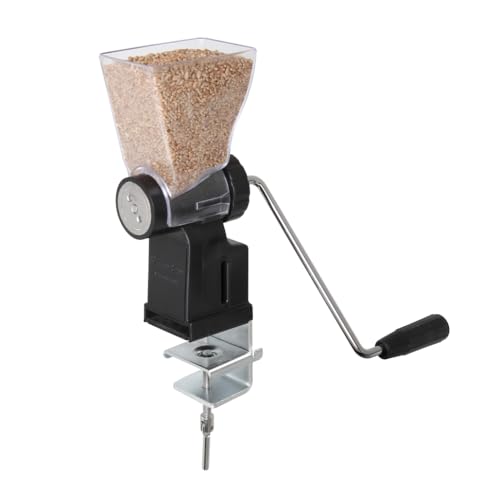
- Stainless burrs handle many dry grains and seeds
- Adjusts from cracked grains to fine flour
- Lightweight, clamp-mounted, and motor-ready
Best For: Small-batch grinding and compact kitchens
Traditional Heavy-Duty Pick
Victoria Manual Cast Iron Grain Mill

- Durable cast iron construction with white iron discs
- Adjustable screw supports varied coarseness
- Clamps securely with a non-slip protector
Best For: Coarse-to-medium grinding and multipurpose food preparation
High-Capacity Workhorse

- Large flywheel provides electricity-free operation
- Adjustable stainless steel discs process dry ingredients
- Large hopper and belt-drive-ready wheel
Best For: Dedicated home, camping, or survival grinding setups
Heavy-Duty Classic

- Heavy-duty cast iron body
- Table clamp for home use
- Handles corn, wheat, oats, and brewing grains
Best For: Home grinding when sturdy construction is the priority
Compact Stainless Pick
Adjustable Stainless Hand Grinder

- 304 stainless-steel construction
- Adjustable coarse-to-fine spring
- Compact, clamped design for small batches
Best For: Personal grinding of dry grains, spices, and coffee
Best Simple Pick

- 2-liter hopper for larger batches
- Three adjustable fineness settings
- Stable carbon-steel body with flywheel
Best For: Frequent grinding where capacity and stability matter
Most Versatile – WonderMill Junior Deluxe
For shoppers comparing manual grain mills, the WonderMill Junior Deluxe stands out for its broad ingredient range and adjustable output. It can produce up to 1.25 cups of flour per minute, with settings ranging from pastry-fine flour to cracked grain.
Best For: Home cooks who want one hand mill for grains, nuts, seeds, spices, oily foods, and nut butter.
Pros:
- Includes stone and stainless steel burr sets for dry, oily, and higher-moisture ingredients.
- Handles ingredients many electric mills cannot, including nuts, seeds, cocoa nibs, coffee beans, and spices.
- Heavy-duty aluminum construction, locking adjustment knob, and secure double-clamp table mount.
- Produces up to 1.25 cups of flour per minute.
Cons:
- At 14 pounds, it is not especially lightweight for a hand-crank mill.
- The broad range of parts and grinding options may be more than needed for basic grain milling.
This is a strong all-purpose choice when versatility matters as much as flour production. Its separate burr sets and secure mounting make it especially practical for users who regularly process more than dry wheat or corn.
Best Traditional Design – Victoria Manual Cast Iron Grain Mill
The Victoria is a traditional cast-iron option for shoppers seeking practical manual grain mills for corn, grains, coffee, seeds, and other foods. Its adjustable screw controls coarseness, while the clamp and rubber protector help stabilize it on tables up to two inches thick.
Best For: Users who want a sturdy, traditional mill for coarse-to-medium grinding and a wide range of kitchen or homestead tasks.
Pros:
- Heavy-duty cast-iron construction with double tin plating and erosion-resistant discs.
- Adjustable screw allows changes to grinding coarseness and fineness.
- Clamps to most tables 1/2 to 2 inches thick and includes a non-slip surface protector.
- Can process grains, corn, coffee, nuts, seeds, spices, vegetables, and more.
Cons:
- Cannot produce a superfine texture or grind whole wheat into fine powder.
- The included warranty is limited to 90 days.
The Victoria is best viewed as a durable general-purpose grinder rather than a flour mill for ultra-fine baking flour. Its cast-iron build and broad ingredient compatibility suit users who value traditional construction and versatility.
Best Lifetime Investment – Country Living Hand Grain Mill
The Country Living Hand Grain Mill is built for shoppers who prioritize long-term durability in manual grain mills. Its solid cast aircraft-aluminum body, industrial-grade sealed bearings, and adjustable range support everything from cracked grain to cake flour.
Best For: Serious home millers who want a durable, adjustable machine backed by a lifetime warranty.
Pros:
- Solid cast aircraft-aluminum construction made in the USA.
- Double-sealed industrial-grade ball bearings are designed for dependable operation.
- Adjusts from cracked grain to cake flour.
- Includes a lifetime warranty and has a two-pound capacity.
Cons:
- At 16 pounds, it is one of the heavier options in this group.
- The supplied details do not specify included burr materials or a grinding speed.
Choose this mill when construction quality and warranty coverage are more important than portability. Its wide adjustment range makes it suitable for both coarse grain preparation and finer baking applications.
Best High-Capacity Mill – Lehman's Manual Power Grain Mill
Lehman’s Manual Power Grain Mill is a practical choice for shoppers who need higher capacity from manual grain mills. Its six-cup hopper, 12-inch flywheel, and stainless steel burrs are designed for dry grains and can support easier hand grinding through added flywheel momentum.
Best For: Bulk home baking, self-sufficient food preparation, and users who want a mill that can also be motorized.
Pros:
- Large six-cup hopper reduces the need for frequent refilling.
- 12-inch iron V-belt flywheel provides momentum for easier hand grinding.
- Electrolytic-polished stainless steel burrs offer a smooth, clean grinding surface.
- Grinds wheat, corn, rye, rice, quinoa, and small beans to pastry flour; it can also be motorized.
Cons:
- At 26 pounds, it is substantially heavier than the other listed mills.
- It is intended for free-flowing, dry grains and does not claim compatibility with oily or wet ingredients.
- The large 14-inch height and 12-inch flywheel require considerable storage space.
This is the strongest fit for capacity-focused buyers who regularly mill larger batches of dry grain. The flywheel and optional motorization add flexibility, but the size and weight make it less convenient for occasional or compact-kitchen use.
Compact Versatility – Kitchen Crop Hand Crank Grain Mill
Kitchen Crop Hand Crank Grain Mill Wheat Flour Grinder, Stainless Steel Metal Burrs (The Grain Mill)
Check Price On AmazonFor shoppers comparing manual grain mills, the Kitchen Crop offers a compact option for small-batch grinding. Its stainless steel burrs handle a broad range of dry, non-oily grains and seeds, while the adjustment dial lets you move from coarse cracked grains to fine, bread-quality flour.
Best For: Small-batch home grinding, compact storage, and users who may later want optional motor assistance.
Pros:
- Grinds wheat, rice, oats, barley, rye, corn, beans, spices, and other dry, non-oily ingredients.
- Adjustable texture ranges from coarse cereal to fine flour.
- Lightweight design weighs less than 3 pounds and includes a two-cup hopper.
- Clamp base fits counters and tables up to 2 inches thick; backed by a 5-year warranty.
Cons:
- Designed for dry, non-oily grains and seeds, so it is not suitable for oily ingredients.
- The optional electric drive motor is sold separately.
- The two-cup hopper is better suited to small batches than high-volume milling.
Choose this model if portability, flexible grind adjustment, and a modest countertop footprint matter most. Its small hopper and lightweight construction make it less appropriate for continuous, large-volume work.
Traditional Heavy-Duty Pick – Victoria Manual Cast Iron Grain Mill
The Victoria is a traditional choice among manual grain mills, using heavy-duty cast iron construction and adjustable white iron discs. Its high hopper supports convenient loading, while the clamp and non-slip protector help keep the mill stable on tables and counters.
Best For: Home users who want a sturdy hand mill for coarse-to-medium grinding, food preparation, and home brewing.
Pros:
- Heavy-duty cast iron body with double tin plating and erosion-resistant discs.
- Adjustable screw changes the grinding coarseness and fineness.
- Versatile enough for grains, coffee, seeds, nuts, spices, dried beans, and other listed foods.
- Clamps to tables 1/2 to 2 inches thick and includes a non-slip surface protector.
Cons:
- Cannot grind to a superfine texture.
- Will not turn whole wheat into fine powder.
- Cast iron construction may be less convenient to move than a lightweight mill.
This Victoria model suits buyers who value traditional construction and broad food-grinding capability over ultra-fine flour production. If fine whole-wheat flour is a priority, its stated limitations are important to consider.
High-Capacity Workhorse – Manual Hand Grain Mill White
For those seeking manual grain mills with a larger, heavier design, this white hand-operated grinder uses stainless steel discs and a large flywheel. It is built for dry grains, beans, spices, herbs, and coffee, with adjustable grinding and a hopper intended to simplify larger grinding sessions.
Best For: Home, camping, survival, or everyday users who need a substantial manual mill and want belt-drive compatibility.
Pros:
- Stainless steel grinding discs are designed for food-safe use and can be dismantled for cleaning.
- Adjustable settings support coarse grist as well as finer processing for coffee and spices.
- Large flywheel and hand crank operate without electricity.
- Large hopper and grooved drive wheel allow compatible motor and belt operation.
Cons:
- At 28.6 pounds, it is substantially heavier and less portable than compact hand mills.
- Only dry materials should be processed; wet, fresh, oily, or sticky foods are unsuitable.
- Its larger dimensions require more storage and workspace.
This is the most substantial option in the group for buyers who prioritize capacity, a large flywheel, and possible belt-driven operation. Its weight and space requirements make it better suited to a dedicated setup than occasional countertop use.
Heavy-Duty Classic – XXL Cast Iron Grain Mill
For shoppers comparing manual grain mills, this cast iron model emphasizes sturdy construction and straightforward hand-crank grinding. Its table clamp is designed for home use with corn, wheat, oats, and brewing grains.
Best For: Home users who want a heavy-duty cast iron grinder for common grains and brewing ingredients.
Pros:
- Heavy-duty cast iron construction
- Includes a table clamp for more secure operation
- Suitable for corn, wheat, oats, and brewing grains
- Large 7.5-pound build
Cons:
- Its 7.5-pound weight may be less convenient to move or store
- The supplied notes do not specify adjustable grind settings
This is a practical choice when durability and stability matter more than portability or a long list of adjustments. Its substantial iron body should appeal to buyers seeking a dedicated countertop mill.
Compact Stainless Pick – Adjustable Stainless Hand Grinder
This compact stainless-steel option is one of the more versatile manual grain mills for small batches. A table clamp, adjustable spring, and low-noise operation support grinding dry grains, spices, coffee beans, and other small ingredients.
Best For: Personal or amateur users who need a compact mill for small quantities and varied dry ingredients.
Pros:
- Durable 304 stainless-steel construction
- Adjustable from coarse cracked grains to finer flour textures
- Table clamp includes an anti-slip rubber pad
- Works with grains, spices, coffee beans, herbs, and coarse salt
Cons:
- Small 0.33-cup capacity requires repeated batches for larger amounts
- Output may contain partial granules rather than a fully uniform grind
- Not recommended for oily ingredients such as peanuts
Choose this model for flexibility and a smaller footprint rather than high-volume flour production. The adjustable spring is useful for changing textures, though the manufacturer notes that results are not completely pure or uniform.
Best Simple Pick – VEVOR Flywheel Grain Mill
Among manual grain mills, this VEVOR model stands out for its large hopper, flywheel, and heavy carbon-steel construction. It offers three fineness settings and is built for grains, corn, spices, coffee beans, nuts, and other kitchen or brewing ingredients.
Best For: Users who want a stable, high-capacity manual mill for repeated grinding and varied ingredients.
Pros:
- Large 0.53-gallon, 2-liter hopper
- Three settings: coarse, medium, and fine
- Wide base helps reduce vibration during operation
- Powder-coated carbon-steel body resists rust and wear
Cons:
- Heavy 32.2-pound construction is not very portable
- Large 17.72-by-12.99-by-15.35-inch footprint needs substantial space
- Motor is not included, despite the flywheel supporting belt and motor drive
This is the strongest fit for buyers prioritizing capacity and stability over compact storage. Its adjustable settings and broad ingredient range add versatility, while the substantial size makes it better suited to a dedicated work area.
How We Picked These Manual Grain Mills
We focused on mills with clear information about construction, grinding capability, capacity, adjustment, and intended use. The selection includes hand-crank models for everyday flour making, heavy-duty cast-iron designs for frequent use, and compact grinders suited to spices, coffee, nuts, or small batches.
Durability and versatility were major considerations. Steel, cast iron, and stone grinding components can each perform well, but they differ in maintenance, food compatibility, and how finely they can grind. We also considered hopper size, flywheel design, mounting requirements, and whether a mill is better suited to occasional kitchen use or serious homesteading.
Quick Comparison
| Best For | What to Look For | Likely Trade-Off |
|---|---|---|
| Fresh wheat flour | Stable mounting, adjustable fineness, durable burrs or stones | More effort than an electric mill |
| Large batches | High hopper capacity and a large flywheel | Heavier and less portable |
| Small kitchens | Compact footprint and straightforward clamping | Slower output |
| Multiple ingredients | Compatible grinding surfaces and easy cleaning | Some foods may require separate settings or parts |
| Emergency preparedness | All-metal construction and no electrical dependence | Requires storage and regular manual operation |
Key Buying Factors for Manual Grain Mills
Grinding Range and Adjustment
Check whether the mill can produce coarse meal, cracked grain, and fine flour. Adjustable settings are particularly useful if you alternate between bread flour, pastry flour, cornmeal, and cereal. “Fine” results also depend on the grain’s moisture, hardness, and the number of passes.
Construction and Grinding Mechanism
Cast iron and steel are common choices for durable hand mills. Stone components can be useful for flour-focused grinding, while steel burrs or plates may offer broader ingredient compatibility. Confirm that the model is designed for oily foods, nuts, or spices before using it for those ingredients.
Capacity, Effort, and Mounting
A larger hopper reduces refilling, but it can also make the mill heavier. Large flywheels may improve momentum and comfort during extended grinding. Make sure your counter, table, or workbench can support the mill securely; an unstable base makes any hand crank harder to use.
Cleaning and Maintenance
Look for accessible grinding surfaces and simple disassembly. Avoid washing components that can rust unless the manufacturer permits it, and dry cast iron thoroughly. Keeping different foods from cross-contaminating the mechanism may require brushing, wiping, or using separate accessories.
Who Should Buy Which Manual Grain Mills?
Choose a compact hand mill if you grind small amounts occasionally or need a model that stores easily. A mid-sized cast-iron mill is a sensible choice for regular flour, meal, and cereal preparation when stability matters. For large households, frequent baking, or preparedness, prioritize a high-capacity hopper, robust frame, and substantial flywheel.
If you want to grind more than dry grains, verify the manufacturer’s ingredient list before buying. Models promoted for nuts, seeds, spices, or coffee may be more versatile, but they may not match a dedicated flour mill’s output. Finally, select the mill you can mount securely and operate comfortably—manual grinding is most useful when the design fits your routine.