Food strainer machines make it easier to turn cooked tomatoes, apples, and other produce into smooth sauces without seeds, skins, or tedious hand processing. The right model can save time whether you prepare occasional batches or preserve garden harvests every season.
This roundup compares manual mills, clamp-on strainers, electric sauce makers, and versatile food-processing machines so you can match capacity, cleanup, and convenience to your kitchen.
Best 10 Food Strainer Machines Picks for 2026
Best Clamp-Mount Food Strainer

- Fine 1.3mm apple/tomato screen included
- Clamp fits 3/4- to 2-1/8-inch countertops
- Handles sauces, purees, jams, and baby food
Best For: Home cooks wanting a versatile manual strainer with optional motor support
Best Traditional Sauce Master
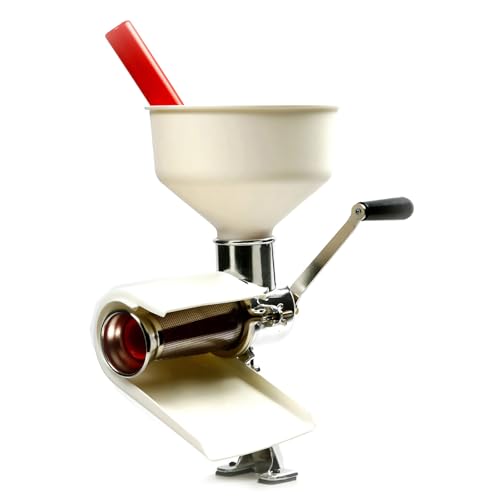
- 3-quart capacity for home batches
- Separates juice and pulp in one operation
- Fine screen and standard spiral included
Best For: Cooks seeking a classic manual fruit and vegetable strainer
Best Adjustable Food Mill
Stainless Steel Rotary Food Mill

- Three discs control puree texture
- Stainless steel body is dishwasher safe
- Useful for potatoes, sauces, soups, and applesauce
Best For: Home cooks needing texture flexibility for soft and cooked foods
Best Electric Food Strainer Machine
VEVOR 800W Electric Tomato Strainer

- Powered processing for continuous sauce making
- Four screens support varied textures
- 304 stainless steel parts and splatter guard
Best For: Large-batch tomato sauce and harvest-season canning
Hand-Crank Favorite
Hungry Artisan 3-Disc Food Mill

- Three discs for coarse, medium, and fine textures
- Separates skins, seeds, and cores
- Manual stainless steel design needs no outlet
Best For: Applesauce, sauces, purees, and canning
Large-Batch Press
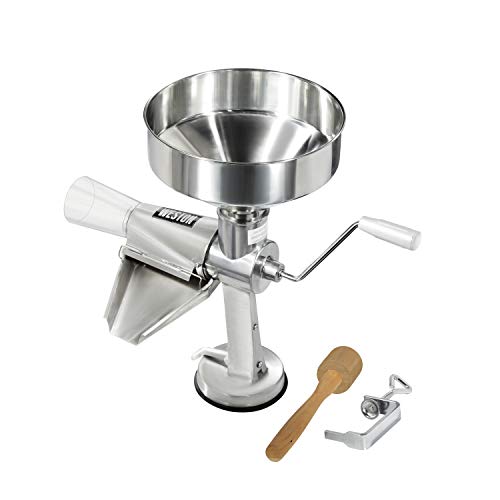
- One-gallon hopper for larger produce batches
- Dual suction-cup and C-clamp mounting
- Includes stomper and 1.5 mm screen
Best For: Tomato sauce, salsa, purees, jams, and preserves
Fine-Filter Set
Marsrut Soy Milk and Yogurt Strainer
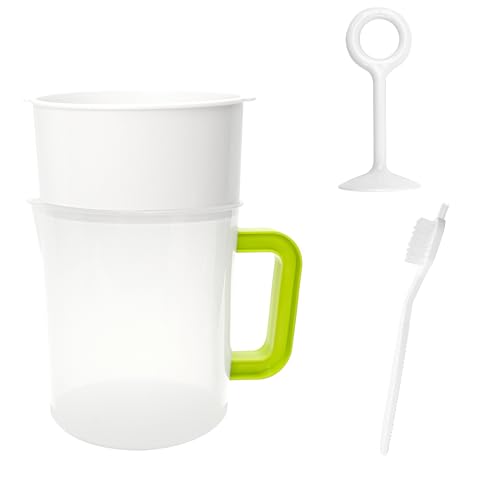
- Five-piece set with pitcher, press, and brush
- 0.5 mm mesh for fine liquid filtering
- Works with yogurt, plant milk, juice, and tea
Best For: Greek yogurt, nut milk, soy milk, juice, and tea
Best for Large-Batch Sauce Making
VEVOR Electric Tomato Strainer

- Separates peels and seeds in one pass
- Includes four screens for varied textures
- Stainless steel parts and splatter-reducing cover
Best For: Harvest-season canning and continuous sauce making
Best for Straightforward Home Canning
Weston Deluxe Electric Tomato Strainer

- One-gallon hopper handles larger batches
- Two-speed motor includes reverse for jam clearing
- Three screens support sauces, purees, and salsa
Best For: Home canning and garden-harvest processing
Best Multi-Use Option
AIRMSEN Meat Grinder and Tomato Press

- Combines tomato pressing with meat grinding
- Includes sausage and kibbeh accessories
- Reverse function and non-slip feet aid operation
Best For: Multi-function home kitchens and meal preparation
Best Clamp-Mount Food Strainer – Johnny Apple Sauce Maker
If you want a versatile option among food strainer machines, the Johnny Apple Sauce Maker uses a hand crank to separate skins and seeds from fruits and vegetables. Its clamp mount fits countertops from 3/4 to 2-1/8 inches thick, while the included 1.3mm screen is suited to fine sauces and purees.
Best For: Home cooks making applesauce, tomato sauce, jams, baby food, purees, and other smooth preparations.
Pros:
- Handles sauces, purees, pie fillings, juices, jams, soups, and baby foods.
- Includes an apple/tomato screen, standard spiral, and instructions.
- Secure clamp provides a broad 10-square-inch mounting surface.
- Supports an optional electric motor, sold separately.
Cons:
- Requires manual cranking unless the optional motor is purchased.
- Additional screens for salsa, pumpkin, and berries cost extra.
This is a practical, expandable choice for small-to-medium home batches, especially if you value a firm countertop mount and a fine included screen.
Best Traditional Sauce Master – Norpro 1951 Sauce Master
The Norpro 1951 is a straightforward choice among food strainer machines for separating juice and pulp in one operation. Its 3-quart capacity and chrome-plated steel screen make it suitable for processing fruits, vegetables, and purees in home kitchens.
Best For: Cooks who want a traditional hand-operated sauce maker for everyday fruit and vegetable preparation.
Pros:
- Processes vegetables, fruits, and purees in a single operation.
- Includes a fine mesh screen, standard spiral, recipe, and instructions.
- Offers a 3-quart, or 95-ounce, capacity.
- Optional berry, pumpkin, and salsa screens are available separately.
Cons:
- Additional specialty screens require a separate purchase.
- Listed as hand wash only.
- The supplied dimensions are relatively large for a countertop tool.
Choose this model if you prefer a classic sauce maker with a useful capacity and simple operation, provided you have room for storage and do not mind hand washing.
Best Adjustable Food Mill – Stainless Steel Rotary Food Mill
This stainless steel rotary food mill stands out among food strainer machines because it includes coarse, medium, and fine discs. The hand-crank design is intended for soft foods such as cooked fruits, vegetables, potatoes, and tomatoes, giving you control over the final texture.
Best For: Everyday cooking, mashed potatoes, applesauce, tomato sauce, soups, and small-batch canning or food preservation.
Pros:
- Includes three interchangeable discs for coarse, medium, and fine textures.
- Stainless steel construction is described as dishwasher safe, stain resistant, and corrosion resistant.
- Works with applesauce, tomato sauce, mashed potatoes, soups, fruits, and vegetables.
- Handle hole supports convenient hanging storage.
Cons:
- Designed for soft or cooked foods rather than hard raw produce.
- Manual cranking is required.
- Only one year of EU spare-part availability is listed.
Its interchangeable discs make this a flexible pick when texture matters more than high-volume throughput, especially for regular meal preparation and seasonal preserving.
Best Electric Food Strainer Machine – VEVOR 800W Electric Tomato Strainer
For larger batches, the VEVOR electric tomato strainer offers powered processing instead of hand cranking. Its stainless steel filter separates peels and seeds, and the included screens support tomato sauce, strawberry jam, pumpkin puree, salsa, and other textures.
Best For: Harvest-season sauce making and continuous processing when manual straining would be tiring.
Pros:
- Electric motor is designed for steady, continuous sauce making.
- Includes four screens with 1mm, 1.5mm, 3mm, and 6mm openings.
- 304 stainless steel parts resist fruit acids and wear.
- Guard cover helps reduce splatter, and removable parts support cleaning.
Cons:
- Heavier than manual options at 7.2 pounds.
- Electric operation requires access to power.
- The listed rated power is 300W, although the product title states 800W maximum.
This is the most suitable option here for repeated or larger-batch processing, particularly when powered operation and multiple screen sizes are more important than portability.
Hand-Crank Favorite – Hungry Artisan 3-Disc Food Mill
For shoppers comparing food strainer machines, the Hungry Artisan 3-Disc Food Mill is a manual option for turning cooked apples, tomatoes, potatoes, and other soft foods into sauces or purees. Its stainless steel construction and interchangeable discs make it useful when you want control over texture without needing an electrical outlet.
Best For: Home cooks who want a versatile, portable food mill for applesauce, tomato sauce, purees, baby food, and canning.
Pros:
- Three stainless steel discs provide coarse, medium, and fine textures.
- Separates skins, seeds, and cores while producing smooth sauce.
- Manual crank works anywhere without an outlet.
- Stainless steel body, discs, and crank are designed for repeated use.
Cons:
- Manual operation requires turning the crank by hand.
- At 2.8 pounds and 15.5 inches long, it may require meaningful storage space.
The three-disc design gives this food mill more texture flexibility than a single-screen model. It is a practical pick for seasonal canning and small-batch kitchen prep, especially where portability matters.
Large-Batch Press – Weston Metal Tomato Strainer
Among food strainer machines for sauce making, the Weston Metal Tomato Strainer stands out for its one-gallon hopper and stainless steel construction. It is designed to process tomatoes and other soft produce while separating skins and seeds, making it well suited to larger batches of sauce, salsa, jam, and puree.
Best For: Canners and gardeners processing larger quantities of tomatoes, apples, soft fruits, and vegetables.
Pros:
- One-gallon hopper supports larger batches.
- Dual mounting system uses either a suction-cup base or C-clamp.
- Stainless steel splash guard and chute help direct puree cleanly.
- Includes a stomper and 1.5 mm multipurpose screen for tomatoes and apples.
Cons:
- The additional accessory kit with other screens is sold separately.
- Its tomato-strainer design may be more equipment than needed for occasional small batches.
The Weston is a strong choice when throughput and secure countertop mounting matter more than compact storage. Its included screen handles tomatoes and apples, while optional screens can expand its puree-making range.
Fine-Filter Set – Marsrut Soy Milk and Yogurt Strainer
For kitchen tasks that need fine filtration rather than grinding, the Marsrut is a compact alternative among food strainer machines. This five-piece set combines a filter, 1.5-liter pitcher, handle, press, and cleaning brush for yogurt, plant-based milk, juice, tea, and similar liquids.
Best For: Beginners making Greek yogurt, soy or nut milk, juice, tea, and other smooth filtered drinks at home.
Pros:
- Includes five coordinated pieces, including a press and cleaning brush.
- Ultra-fine 0.5 mm mesh is designed for smooth, residue-free filtering.
- Pitcher holds 1.5 liters and can process up to 1.6 quarts of yogurt.
- Compact polypropylene set rinses clean with water and the included brush.
Cons:
- It is intended for liquids and yogurt rather than separating cooked produce skins and seeds.
- The polypropylene construction may be less substantial than a stainless steel food mill.
- Buyers should confirm the pitcher size before purchasing.
The Marsrut is best viewed as a fine-filtering and yogurt-making kit, not a traditional sauce mill. Its press, pitcher, and brush make it a convenient choice for small kitchen batches and plant-based milk preparation.
Best for Large-Batch Sauce Making – VEVOR Electric Tomato Strainer
For shoppers comparing food strainer machines for harvest-season processing, this VEVOR model is built around continuous tomato, fruit, and vegetable straining. Its stainless steel screens separate peels and seeds in one pass, while the included screen sizes support smooth sauces, purees, salsa, and jam.
Best For: Large-batch sauce making, canning, and users who want multiple texture options.
Pros:
- Separates skins and seeds for smoother sauce, puree, and juice.
- Includes four screens: 1 mm, 1.5 mm, 3 mm, and 6 mm.
- 304 stainless steel components resist fruit acids and wear.
- Guard cover helps reduce splatter during straining.
Cons:
- At 7.2 pounds, it may be less convenient to move and store than smaller machines.
- The product listing gives a rated power of 300W and a maximum of 800W, which may require careful comparison with similarly rated models.
Choose this machine when throughput and screen flexibility matter most. Its removable core parts and included cleaning brush also make routine rinsing more manageable after extended processing.
Best for Straightforward Home Canning – Weston Deluxe Electric Tomato Strainer
This Weston model is one of the more practical food strainer machines for home preservers who want a dedicated tomato and soft-produce processor. A one-gallon hopper, two-speed 250W motor, and three stainless steel screens cover common sauce, puree, jelly, and salsa tasks.
Best For: Home canning, garden harvests, and bulk batches of tomatoes or soft fruits.
Pros:
- Quickly removes skins and separates seeds without coring.
- Two speeds include forward processing and reverse operation for helping clear jams.
- One-gallon hopper supports larger batches without frequent refilling.
- Includes 1.5 mm, 3 mm, and 6 mm stainless steel screens plus a stomper.
Cons:
- The included screen selection is less extensive than models with four or more screens.
- Plastic and stainless steel construction may not feel as uniformly rugged as an all-metal design.
Weston is a sensible choice for dedicated sauce and preserving work rather than general-purpose grinding. The one-year warranty and reverse function add useful reassurance for routine seasonal processing.
Best Multi-Use Option – AIRMSEN Meat Grinder and Tomato Press
Among food strainer machines, the AIRMSEN stands out for combining tomato pressing with meat grinding and sausage or kibbeh making. It includes a dedicated tomato strainer kit alongside three grinding plates, making it useful for cooks who need more than a single-purpose sauce machine.
Best For: Home kitchens that want one appliance for tomato sauce, meat grinding, sausage, and kibbeh preparation.
Pros:
- Combines tomato straining, meat grinding, sausage making, and kibbeh preparation.
- Includes 5 mm, 7 mm, and 12 mm grinding plates.
- Reverse function helps clear jams, while non-slip feet improve stability.
- Detachable components simplify hand cleaning and maintenance.
Cons:
- It is not dishwasher safe and requires hand washing.
- The listed wattage is 300W despite a claimed 2500W peak motor rating, so power specifications merit careful comparison.
- Its tomato-pressing setup may be less specialized than a dedicated sauce strainer.
This is the better fit when versatility outweighs dedicated tomato-processing features. Choose it for a compact multi-function setup, but expect more hands-on cleanup and a broader assembly than with a single-purpose press.
How We Picked the Best Food Strainer Machines
We compared these Food Strainer Machines by looking at processing method, capacity, construction, intended foods, ease of cleaning, and practical workload. Manual models can be affordable and dependable for smaller batches, while electric machines are better suited to frequent sauce making and larger harvests. We also considered useful accessories, disc options, hopper size, clamp or base stability, and whether each machine is designed primarily for straining or offers broader food-preparation functions.
Quick Comparison
| Type | Best for | Main advantage | Trade-off |
|---|---|---|---|
| Clamp-on manual strainer | Occasional sauces and applesauce | Simple, compact, and affordable | Requires hand cranking and a secure counter edge |
| Rotary food mill | Small to medium batches | No electricity and easy control | More physical effort |
| Electric tomato strainer | Garden harvests and frequent canning | Faster, less manual work | Higher cost and more parts to clean |
| Multi-purpose electric machine | Users wanting added versatility | Can grind or process more than produce | Often larger and more complex |
Key Buying Factors for Food Strainer Machines
Manual or Electric Operation
Choose a manual strainer if you make modest quantities and value simplicity. Electric models are more practical for bushels of tomatoes, repeated canning sessions, or anyone who wants to reduce hand and arm fatigue.
Capacity and Throughput
Check the hopper size, motor rating, and expected processing rate rather than relying only on maximum wattage claims. A larger hopper can reduce refilling, but a compact unit may store more easily.
Materials and Stability
Stainless steel components generally offer durability and resist staining. For clamp-style models, verify that the clamp fits your counter or table. A stable base matters when processing firm or fibrous produce.
Discs, Screens, and Cleanup
Multiple screens let you adjust texture for applesauce, tomato sauce, juice, or other preparations. Removable parts and dishwasher-safe components can make a major difference after a large batch. Always confirm cleaning instructions before purchasing.
Food Safety and Intended Use
Use the machine according to its instructions, especially when preparing produce for canning. Straining removes skins and seeds, but it does not replace safe heating, acidity, storage, or tested preservation procedures.
Who Should Buy Which Food Strainer Machines?
Buy a basic clamp-on strainer or rotary food mill if you want an inexpensive option for occasional applesauce or tomato sauce. Choose a multi-disc mill when texture control and electricity-free operation are priorities. A manual stainless-steel model is a strong fit for cooks who want durable construction and moderate batch capacity.
For serious gardeners and home canners, an electric tomato strainer is usually the better investment because it speeds up repetitive processing. Pick a deluxe electric model when you want a purpose-built sauce maker, or consider a multi-function grinder and strainer if you also need meat-grinding capability. If your main goal is filtering nut milk, yogurt, or juice rather than processing cooked produce, a dedicated filter-bag-style set may be more appropriate.