Choosing among food strainer machines for small businesses is easier when you focus on production volume, cleanup time, and the types of sauces, jams, or purées you make most often.
This roundup compares 10 electric and manual tomato strainers, food mills, and sauce makers across practical factors including hopper size, throughput, construction, and operating convenience.
Best 10 Food Strainer Machines for Small Businesses Picks for 2026
Compact Italian Tomato Specialist
OMRA Spremy Electric Tomato Strainer

- Processes up to 330 lb of tomatoes per hour
- Automatically separates puree from seeds and skin
- Compact 1/4 HP design made in Italy
Best For: Small tomato-sauce businesses needing a portable strainer
Versatile Manual Sauce Maker
- Separates juice and pulp in one operation
- Includes fine mesh screen and standard spiral
- Optional screens support berries, pumpkin, and salsa
Best For: Small-batch manual sauce and puree preparation
High-Throughput Stainless Workhorse
COSTWAY 450W Electric Tomato Strainer
- Rated for 200–350 lb of sauce per hour
- Large 8.5-inch chute and 450W motor
- 304 stainless steel with tool-free disassembly
Best For: Higher-volume commercial sauce and preserve production
Durable Italian Production Press
Reber N.3 Electric Tomato Strainer

- Processes up to 309 lb of tomatoes per hour
- 450W induction motor supports continuous operation
- Optional attachments expand food-preparation capabilities
Best For: Continuous tomato processing with room to expand
Stainless Steel Batch Strainer
- One-gallon stainless steel hopper
- Dual suction-cup and C-clamp mounting
- Includes 1.5mm screen and stomper
Best For: Manual small-batch sauce, puree, and preserve production
Motor-Assisted Sauce Maker

- Includes electric motor and hand-crank operation
- 1.3mm apple/tomato screen
- Clamp fits 3/4- to 2-1/8-inch countertops
Best For: Flexible countertop processing of sauces, purees, and fillings
High-Volume Electric Strainer
Weston Deluxe Electric Tomato Strainer

- 250-watt, two-speed motor
- One-gallon hopper for larger batches
- Includes 1.5mm, 3mm, and 6mm screens
Best For: Powered batch processing with multiple puree textures
Durable Sauce-Making Workhorse
- 304 stainless-steel food-contact parts
- 370W copper motor with large 9-inch funnel
- Adjustable trough and low-noise operation
Best For: Small businesses making tomato sauces, fruit sauces, and jams
Harvest-Season Efficiency Pick

- Single-pass peel and seed separation
- Large hopper for fewer refills
- Tool-free disassembly for quick cleaning
Best For: Frequent tomato processing, canning, puree, and jam production
High-Output Commercial Choice

- Rated for 200–350 pounds per hour
- 450W copper motor with 8.5-inch feed chute
- 304 stainless steel and tool-free cleanup
Best For: Higher-volume sauce, jam, and fruit-processing work
Compact Italian Tomato Specialist – OMRA Spremy Electric Tomato Strainer
For small businesses focused on tomato sauce, the OMRA Spremy is a compact option among food strainer machines for small businesses. Its 1/4 HP motor and masticating-style auger separate puree from seeds and skins while handling fresh or cooked tomatoes.
Best For: Small-scale tomato sauce, puree, and apple-processing operations that value a portable Italian-made machine.
Pros:
- Processes up to 330 pounds of tomatoes per hour.
- Separates seeds and skins automatically.
- Uses a stainless steel hopper, die-cast metal housing, and food-grade nylon auger.
- Cooling-fan-equipped motor and compact portable design.
Cons:
- Its 1/4 HP, 225-watt motor is less powerful than the 450W alternatives here.
- The listed voltage is 220V, so compatibility should be confirmed before purchase.
- It is more specialized for tomato and apple processing than broad food milling.
The OMRA is appealing when workspace and portability matter more than maximum throughput. Its automatic separation and gentle auger action make it a practical fit for small batches and tomato-focused production.
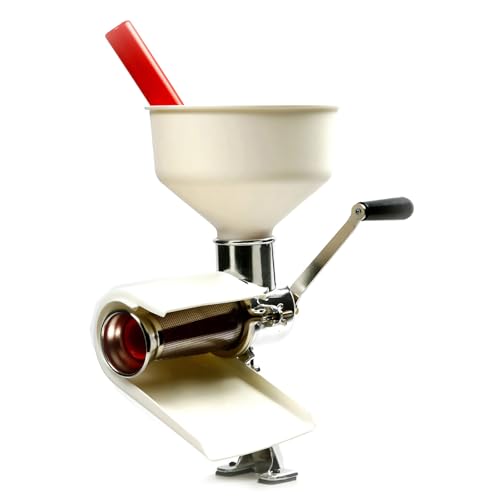
Versatile Manual Sauce Maker – Norpro 1951 Sauce Master
The Norpro 1951 is a manual alternative for small businesses comparing food strainer machines for small businesses. It forces fruits, vegetables, and purees through a chrome-plated steel screen, separating juice and pulp in one operation without requiring electricity.
Best For: Small-batch preserves, sauces, and purees where a 3-quart manual strainer is sufficient.
Pros:
- Handles vegetables, fruits, and purees.
- Includes a fine mesh screen, standard spiral, recipe, and instruction booklet.
- Additional berry, pumpkin, and salsa screens are available separately.
- Its 3-quart capacity suits controlled small batches.
Cons:
- Manual operation requires more hands-on effort than electric models.
- Only the standard fine mesh screen and spiral are included.
- Hand-wash care is specified.
The Sauce Master makes sense for businesses prioritizing low equipment complexity and flexible small-batch work. It will be slower and more labor-intensive than powered machines, but its optional screens broaden its processing range.
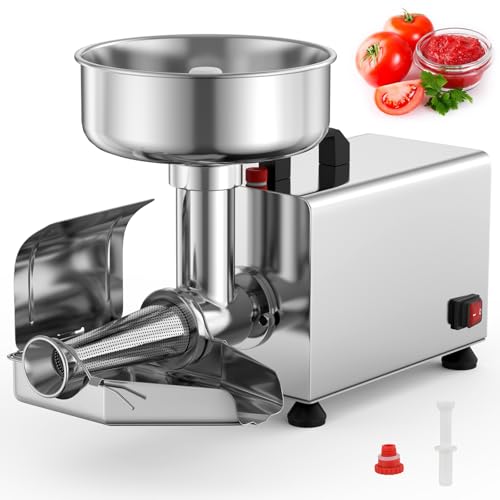
High-Throughput Stainless Workhorse – COSTWAY 450W Electric Tomato Strainer
The COSTWAY 450W model is built for businesses that need higher throughput from food strainer machines for small businesses. Its large feed chute and full-copper motor are rated to process 200–350 pounds of sauce per hour, while the stainless-steel construction supports frequent use.
Best For: Small commercial kitchens and preserve makers processing tomatoes, berries, pineapple, and other fruits at higher volumes.
Pros:
- Rated output of 200–350 pounds per hour.
- 450W motor and 8.5-inch feed chute support efficient feeding.
- Food-grade 304 stainless steel construction.
- Tool-free disassembly and dishwasher-safe detachable parts simplify cleanup.
Cons:
- At 22 pounds, it is substantially less portable than compact countertop options.
- The product-care instructions specify hand washing despite dishwasher-safe detachable parts.
- Its 110–120V electrical requirement must match the workspace.
The COSTWAY stands out when speed, capacity, and cleanup convenience are priorities. Its safety features, adjustable trough, and broad fruit capability make it a strong production-oriented choice for a growing preserve operation.
Durable Italian Production Press – Reber N.3 Electric Tomato Strainer
The Reber N.3 is a durable choice for small businesses seeking food strainer machines for small businesses that can support continuous production. Its 450W induction motor is rated for up to 309 pounds per hour, while the cast-iron body and stainless steel processing components are designed for long-term use.
Best For: Small commercial sauce and preserve operations needing continuous tomato processing with optional expansion into other food-preparation tasks.
Pros:
- Processes up to 309 pounds of tomatoes per hour.
- 450W induction motor supports continuous operation.
- Long Life oil-bath gearbox is designed for maintenance-free durability.
- Optional attachments can add pasta pressing, meat grinding, grating, and mixing.
Cons:
- At 21 pounds, it is not the lightest option for frequent relocation.
- Hand-wash-only care may increase cleanup time.
- Optional attachments are not included.
The Reber N.3 offers a compelling balance of throughput and robust construction for businesses processing large tomato batches. Its accessory compatibility adds future flexibility, though the base unit is best suited to operators prepared for manual cleaning and a larger footprint.
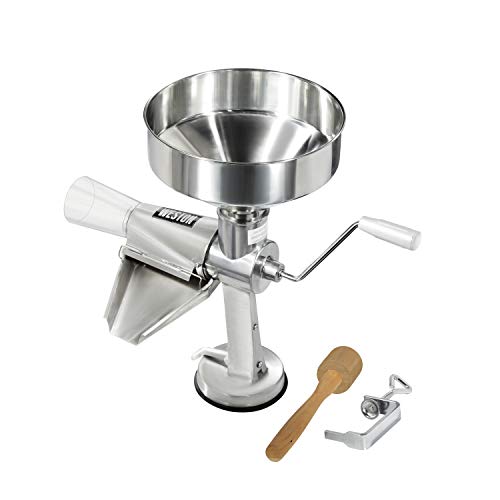
Stainless Steel Batch Strainer – Weston Metal Tomato Strainer
For small businesses comparing food strainer machines for small businesses, this manual Weston model offers a durable stainless steel setup for sauces, jams, preserves, purees, and salsa. Its one-gallon hopper supports relatively large batches, while the dual-mount system helps secure it to different flat work surfaces.
Best For: Small-scale producers who want a manual strainer with a large hopper and flexible countertop or table mounting.
Pros:
- One-gallon stainless steel hopper handles larger batches.
- Dual suction-cup and C-clamp mounting options suit various flat surfaces.
- Includes a stomper and 1.5mm multipurpose screen.
- Splash guard and puree chute support cleaner processing.
Cons:
- Manual operation requires continued hand-cranking.
- Only the 1.5mm screen is included; additional screens are sold separately.
This is a practical choice when material durability, mounting flexibility, and batch capacity matter more than electric operation or included screen variety.
Motor-Assisted Sauce Maker – Johnny Apple Sauce Maker
Among food strainer machines for small businesses, the Johnny Apple Sauce Maker stands out for offering both hand-crank and included electric-motor operation. Its clamp-based design separates skins and seeds for purees, juices, fillings, jams, soups, baby foods, and sauces.
Best For: Small businesses that want the flexibility to switch between manual and motor-assisted processing on standard countertops.
Pros:
- Includes an electric motor while retaining hand-crank capability.
- Handles a broad range of produce-based foods and sauces.
- Sturdy cast aluminum body with stainless steel screens.
- Clamp fits countertops from 3/4 to 2-1/8 inches thick.
Cons:
- Includes a 1.3mm apple/tomato screen but no stated set of additional screens.
- Clamp mounting requires a suitable countertop edge.
This model offers useful operational flexibility for businesses that may need powered help at times but still want a manual backup.
High-Volume Electric Strainer – Weston Deluxe Electric Tomato Strainer
For businesses seeking food strainer machines for small businesses with less manual effort, this Weston electric tomato strainer combines a 250-watt motor with a one-gallon hopper. It is designed to remove skins and separate seeds from soft produce for sauces, purees, jellies, salsa, and preservation work.
Best For: Small commercial kitchens and producers processing larger batches who need powered straining and multiple texture options.
Pros:
- 250-watt motor provides electric processing with two speeds.
- Reverse speed helps address potential jams.
- One-gallon hopper supports larger produce batches.
- Includes 1.5mm, 3mm, and 6mm stainless steel screens.
Cons:
- Requires access to a 120-volt electrical outlet.
- Electric components add more equipment complexity than a manual model.
- Warranty is listed as one year.
With its powered operation, large hopper, and three included screen sizes, this is the strongest fit of the three for repeat processing and varied sauce or puree textures.
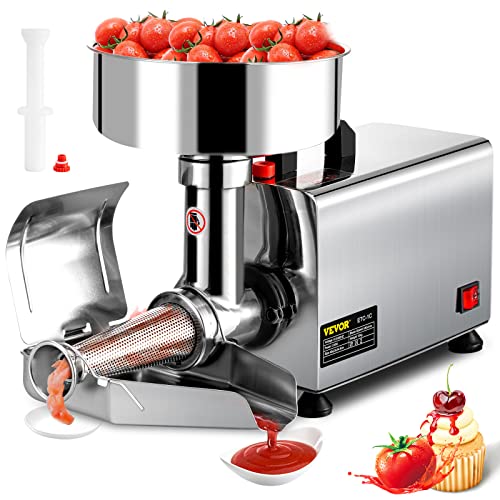
Durable Sauce-Making Workhorse – VBENLEM 370W Tomato Strainer
For small businesses seeking food strainer machines for small businesses, the VBENLEM offers a stainless-steel design, a 370W copper motor, and a stated processing capacity of up to 90–160 kg per hour. Its adjustable trough and large funnel support steady sauce production.
Best For: Small commercial kitchens processing tomatoes and making ketchup, fruit sauces, or jams.
Pros:
- Food-contact components use 304 stainless steel, while the overall machine is designed for durability.
- Powerful 370W pure copper motor supports high-volume processing.
- Adjustable trough, trough brace, and 9-inch funnel improve feeding and sauce collection.
- Designed for relatively quiet operation and easier cleaning.
Cons:
- At 22 pounds, it is less convenient to move frequently.
- The listed capacity and output range may vary with ingredients and preparation.
- Its primary focus is tomato and soft-fruit sauce processing rather than general-purpose straining.
This is a practical choice when durable construction, a generous feed funnel, and straightforward sauce production matter more than portability.
Harvest-Season Efficiency Pick – VEVOR 370W Food Mill
The VEVOR is one of the more efficiency-focused food strainer machines for small businesses, combining a 370W motor with a large hopper and stainless-steel filter screen. It separates peels and seeds in a single pass for sauce, puree, and juice production.
Best For: Small commercial operations handling frequent tomato processing, bulk canning, and fruit preserves.
Pros:
- Stainless-steel screen separates peels and seeds for smoother results.
- Large hopper reduces the need for frequent refilling during larger batches.
- Core components disassemble without tools and can be rinsed clean quickly.
- Stainless-steel hopper, tray, guard, and screen are suited to frequent use.
Cons:
- Tomatoes should be cut into smaller pieces to help reduce clogging.
- Its 21.7-pound weight may limit easy repositioning.
- The listed 200 pounds-per-hour figure depends on ingredients and operating conditions.
Choose this model if reducing manual straining steps and cleanup time is a priority during harvest-season or recurring batch production.
High-Output Commercial Choice – 450W Electric Tomato Strainer
For businesses prioritizing throughput, this 450W electric tomato strainer is rated to process 200–350 pounds per hour. Its 304 stainless-steel construction, enclosed motor guard, safety pusher, and tool-free cleanup make it well suited to busy sauce and preserve production.
Best For: Small commercial kitchens needing higher stated output for tomatoes, berries, pineapples, jams, and sauces.
Pros:
- 450W all-copper motor provides the highest stated output among these options.
- 8.5-inch feed chute and included pusher support consistent feeding.
- Food-grade 304 stainless steel offers a rugged, easy-to-clean build.
- Enclosed motor guard, insulated waterproof switch, and anti-slip feet add practical safety features.
Cons:
- Its 22-pound weight and larger 20.5-by-11-inch footprint require dedicated counter space.
- The 200–350 pounds-per-hour rating may depend on ingredient preparation and operating conditions.
- The supplied notes do not specify a separate output adjustment beyond the 1.2 mm mesh opening.
This is the strongest fit for operators who value maximum stated throughput and versatile fruit processing, provided they have sufficient workspace and electrical access.
How We Picked the Best Food Strainer Machines for Small Businesses
We focused on machines that can separate skins and seeds from tomatoes, fruit, and other cooked produce with less manual labor than a standard food mill. The selection includes compact countertop models, higher-throughput commercial-style machines, and a manual option for businesses that value simplicity or operate without dependable power.
Our comparison emphasizes motor power, stated processing capacity, material quality, feeding and clamping design, ease of cleaning, and suitability for repeated small-batch production. Capacity claims can vary with produce type, preparation, and operator technique, so treat advertised rates as reference points rather than guaranteed output.
Quick Comparison
| What to Compare | Best Fit |
|---|---|
| Compact electric design | Small kitchens, farm stands, and occasional production |
| Higher stated throughput | Businesses processing large harvests or frequent batches |
| Stainless-steel construction | Heavy use, easier sanitation, and long-term durability |
| Manual operation | Low-volume work, backup use, or areas without convenient power |
| Clamp-based or stable mounting | Safer, less tiring operation during extended sessions |
Key Buying Factors for Food Strainer Machines for Small Businesses
Capacity and Real-World Throughput
Estimate your busiest batch rather than your average batch. A machine rated around 200 pounds per hour may be more practical than a slower model if you process restaurant orders, preserve a large crop, or need to finish production quickly. Leave headroom for prep, loading, pauses, and cleanup.
Motor Power and Duty Cycle
Higher wattage can help with sustained processing and firmer produce, but it does not alone determine performance. Check whether the design is intended for continuous commercial-style use, and avoid overloading the hopper. A thermal shutoff or rest period may affect workflow.
Materials, Sanitation, and Maintenance
Stainless-steel contact surfaces are valuable for durability and cleaning, especially when working with acidic tomatoes. Confirm which parts remove for washing, whether the screen and auger are easy to access, and whether replacement screens or wear parts are available.
Setup and Workspace
Measure counter space, hopper clearance, outlet height, and access to a grounded outlet. Clamp-mounted models need a suitable edge, while heavier electric units need a stable, level work surface. Verify voltage before buying.
Who Should Buy Which Food Strainer Machines for Small Businesses?
Choose a compact electric strainer if you make sauces, jams, or purées in modest but regular batches and want faster results without installing a large processing line.
Choose a higher-capacity commercial-style model if speed is central to your operation, particularly for farm products, catering, markets, or wholesale orders. Prioritize stable construction and accessible replacement parts.
Choose a manual or clamp-based machine if your volume is limited, your budget is tight, or you need a dependable backup that does not rely on electricity.
Before ordering, compare the machine’s actual footprint, power requirements, included screens, warranty, and cleaning procedure with your daily workflow. The best choice is the one that meets peak demand without creating unnecessary setup, storage, or maintenance work.