The best dough sheeters for home bakers make it easier to roll pastry, pasta, pizza dough, fondant, and laminated dough to a consistent thickness. The right model can save time and reduce uneven edges, especially when a rolling pin becomes tiring or imprecise.
We compared manual and electric machines across working width, thickness adjustment, countertop footprint, cleaning, and ease of storage so you can choose a practical sheeter for your kitchen and baking routine.
Best 10 Dough Sheeters for Home Bakers Picks for 2026
Most Compact

- 0–25 mm adjustable thickness
- Foldable stainless steel design
- Suitable for pastry, pizza, and pie dough
Best For: Space-conscious home bakers and small batches
Best Board Set
12-Inch Foldable Dough Sheeter

- Includes rough and smooth PE boards
- 0.2–17.5 mm thickness adjustment
- Foldable countertop design
Best For: Home bakers wanting included prep boards
Best Wide Capacity
15.5-Inch Manual Dough Sheeter

- Extra-wide board for larger batches
- Stainless steel frame with non-slip feet
- Low-friction manual rolling system
Best For: Serious home bakers and small baking businesses
Best Thickness Range
12-Inch Commercial-Style Sheeter
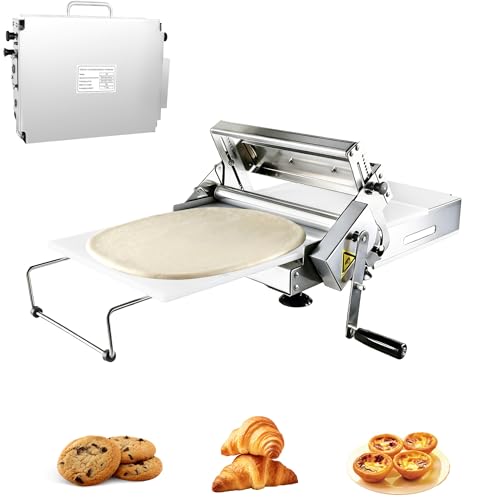
- 0.2–27 mm adjustable thickness
- Foldable stainless steel construction
- Includes shaping accessories and mobility wheel
Best For: Versatile home and commercial kitchen use
Best Overall Manual Control
Folding Stainless Steel Dough Sheeter

- 0–25 mm range with approximately 55 settings
- Manual, electricity-free operation
- Folds flat for compact storage
Best For: Home bakers who want precise manual thickness control
Best Electric Option
Foldable Commercial Dough Sheeter

- Automatic rolling with a DC power adapter
- Adjustable roller clearance for varied doughs
- Foldable frame and rolling wheels
Best For: Home baking rooms and small bakeries needing powered rolling
Best Portable Pick

- Lightweight 7.5 kg portable design
- 0.5–25 mm range with up to 55 options
- Folds for storage and assembles in 10 seconds
Best For: Portable, quiet dough rolling at home or on the go
Electric Efficiency Pick
Compact Electric Dough Sheeter

- 0.4–4 mm adjustable thickness
- 250W motor reduces hand rolling
- 15.7-inch stainless-steel rolling area
Best For: Small-batch home baking with less manual effort
Space-Saving Manual Pick

- Folds for easier storage
- 0–17.5 mm thickness adjustment
- 304 stainless-steel construction
Best For: Hands-on rolling in compact home kitchens
Versatile Manual Pick
Removable-Handle Dough Sheeter

- 0–12 mm dial-adjustable thickness
- Detachable parts ease cleaning and storage
- Works with dough, fondant, and sugar paste
Best For: Multi-purpose pastry and decorating prep
Most Compact – Foldable Manual Dough Sheeter
For home bakers seeking dough sheeters for home bakers that are easy to store, this manual model combines foldability with a broad 0–25 mm thickness range. Its stainless steel and food-grade PE construction suits small-batch pastry and pizza preparation without requiring electricity.
Best For: Home kitchens, cottage bakers, and occasional small-batch pastry making.
Pros:
- Adjusts from ultra-thin sheets to 25 mm-thick dough.
- Foldable, non-slip design saves storage space.
- Manual operation works without cords or motor noise.
- Handles croissants, puff pastry, pie, cookie, and pizza dough.
Cons:
- Manual cranking requires more effort than an electric machine.
- Its listed dimensions and capacity may be better suited to small batches.
This is a practical pick when storage space and versatility matter most. The folding frame and wide thickness adjustment make it flexible for everyday home baking, though frequent high-volume users may want a larger commercial-style unit.
Best Board Set – 12-Inch Foldable Dough Sheeter
This 12-inch option is a useful choice among dough sheeters for home bakers, especially if you want included work surfaces and a compact countertop footprint. It comes with two food-grade PE boards and provides fine thickness control for pastry, pasta, pizza, and fondant.
Best For: Home bakers who want a ready-to-use manual sheeter with separate rough and smooth boards.
Pros:
- Includes two 27.5-inch food-grade PE sheeter boards.
- Adjusts from 0.2 to 17.5 mm for varied dough applications.
- Folded dimensions help conserve kitchen storage space.
- Stainless steel construction is rust-resistant and easy to wipe clean.
Cons:
- Manual operation is less convenient for high-volume production.
- Its 12-inch format may limit the width of each dough sheet.
The included boards add flexibility and help keep preparation organized. With a moderate thickness range and foldable frame, it balances everyday usability with storage convenience for home baking.
Best Wide Capacity – 15.5-Inch Manual Dough Sheeter
For buyers comparing dough sheeters for home bakers with small-business ambitions, this 15.5-inch manual model offers an extra-wide dough board for larger sheets. Its stainless steel frame, non-slip feet, rotating handle, and detachable design are aimed at consistent, lower-effort rolling.
Best For: Serious home bakers, small bakeries, cafes, and pizzerias handling larger batches.
Pros:
- 15.5-inch width supports larger dough sheets in one pass.
- Adjustable control knob accommodates different baking projects.
- Non-slip feet and solid construction promote stability.
- Designed for pizza, croissants, puff pastry, flatbread, fondant, and more.
Cons:
- At 35 pounds, it is substantially heavier than the other listed manual models.
- Its 40.5-inch length requires considerable counter and storage space.
- The supplied notes do not specify an exact thickness range.
This model prioritizes working width and stability over portability. It is a stronger fit for dedicated baking spaces or frequent production, while casual users may find its size and weight excessive.
Best Thickness Range – 12-Inch Commercial-Style Sheeter
This foldable stainless steel machine is one of the more versatile dough sheeters for home bakers who also want commercial-style features. Its manual roller adjusts from 0.2 to 27 mm and includes a countertop design, wheel for mobility, lattice, and pin accessories.
Best For: Home or commercial kitchens needing a broad thickness range and foldable storage.
Pros:
- Wide 0.2–27 mm adjustment range covers thin and thick dough.
- Foldable structure helps save space between uses.
- Stainless steel construction is suited to regular dough processing.
- Includes tools and accessories for pressing and shaping.
Cons:
- Manual operation may be tiring during extended production.
- The notes do not provide exact open or folded dimensions.
- Included components are listed generally, so accessory details may require verification.
Its standout feature is the unusually broad thickness adjustment, making it adaptable from thin pasta to thicker pastry layers. The foldable frame and mobility wheel add practicality, but buyers should confirm the full footprint before allocating counter space.
Best Overall Manual Control – Folding Stainless Steel Dough Sheeter
For home bakers comparing dough sheeters for home bakers, this folding countertop model stands out for its broad 0–25 mm adjustment range and manual operation. Its stainless-steel dough-contact components and compact folding design make it practical for kitchens where precise thickness control and storage space both matter.
Best For: Home bakers making pasta, pizza, pastries, dumpling wrappers, cookies, and other doughs who prefer a non-electric machine.
Pros:
- Offers approximately 55 thickness settings across a 0–25 mm range.
- Manual operation requires no electricity and uses an ergonomic handle.
- Folds flat for more compact storage.
- Food-grade stainless-steel contact parts are designed for straightforward wiping and cleaning.
Cons:
- Manual operation requires more hands-on effort than an electric sheeter.
- Its countertop footprint may still be substantial while fully assembled.
This is a versatile choice when fine adjustment and foldable storage are higher priorities than automated rolling. It suits varied home baking projects, especially for users who want direct control over the sheeting process.
Best Electric Option – Foldable Commercial Dough Sheeter
Among dough sheeters for home bakers, this electric model is designed for users who want automated rolling and easier movement around a home baking room or small bakery. Its adjustable roller clearance, stainless-steel construction, and foldable frame combine convenience with a more commercial-style format.
Best For: Home bakers and small bakery operators who want electric dough rolling, adjustable thickness, and a movable base.
Pros:
- Electric drive provides automatic dough rolling with a US-standard plug power adapter.
- Fine-tuning knob adjusts the roller clearance for different dough types.
- Foldable and removable frame helps reduce storage demands.
- Rolling wheels make the machine easier to shift when needed.
Cons:
- Requires access to power, unlike manual countertop models.
- The larger 48-inch listed length may be difficult to accommodate in compact kitchens.
- Its commercial-style frame may be more equipment than occasional home bakers need.
This model is a strong fit when reduced hand rolling and higher workflow efficiency matter most. Before buying, measure the available space carefully, since the listed dimensions are substantial even though the frame can fold or detach.
Best Portable Pick – Compact Manual Dough Sheeter
For home bakers seeking dough sheeters for home bakers that can move beyond the kitchen, this compact manual machine offers a lightweight 7.5 kg design, quick assembly, and foldable storage. Its adjustable range accommodates both very thin wrappers and thicker pie or pizza dough.
Best For: Home users who need a portable, electricity-free sheeter for kitchens, camping, RVs, gatherings, or small events.
Pros:
- Manual design operates without electricity or noise.
- Offers 0.5–25 mm adjustment with up to 55 thickness options.
- Foldable body and 10-second assembly support convenient storage and transport.
- Non-stick-coated rollers, a non-slip base, and wipe-clean construction support easier use.
Cons:
- Manual rolling requires user effort.
- Its 12-inch width may be limiting for especially large dough sheets.
- It lacks the automated operation of an electric model.
This is the most travel-friendly option of the three, while still offering unusually fine thickness adjustment for a manual machine. It makes sense for bakers who value portability, quiet operation, and flexible dough preparation over powered convenience.
Electric Efficiency Pick – Compact Electric Dough Sheeter
For home bakers looking for dough sheeters for home bakers, this electric model reduces repetitive hand rolling while offering adjustable thickness for pastry, pizza, pie crust, and other doughs. Its 15.7-inch rolling area and countertop footprint suit small-batch preparation.
Best For: Home bakers and small pastry setups that want powered rolling for portions from 50 to 500 g.
Pros:
- Adjustable 0.4–4 mm thickness range
- 250W motor reduces manual rolling
- 304 stainless-steel rollers and feeding tray are easy to wipe clean
- Non-slip feet and a compact countertop design support stable operation
Cons:
- Continuous operation is limited to 30 minutes before a 10–15 minute cool-down
- Its 400 mm rolling width may require dedicated countertop space
This is the most convenient option here for repeated small-batch rolling, especially when minimizing hand fatigue matters. The thickness range is geared toward relatively thin sheets, while the motor duty cycle is worth considering for longer sessions.
Space-Saving Manual Pick – Folding Manual Dough Sheeter
This folding manual model is a practical choice among dough sheeters for home bakers who prefer hands-on control and easy storage. It provides adjustable thickness for pizza dough, croissants, puff pastry, bread, and laminated dough without requiring electricity.
Best For: Home kitchens and small bakeries that need a manual countertop sheeter with a foldable design.
Pros:
- Foldable construction helps reduce storage and workspace requirements
- Thickness adjustment from 0 to 17.5 mm
- 304 stainless-steel construction supports hygiene and straightforward cleaning
- Includes a hand crank and two sheeter boards
Cons:
- Manual operation requires more physical effort than an electric model
- The listed dimensions are 31.4 inches deep, so it may need substantial counter depth when set up
Choose this sheeter if storage flexibility and broad thickness adjustment matter more than motorized convenience. Its foldable format is particularly useful when the machine cannot remain permanently on the counter.
Versatile Manual Pick – Removable-Handle Dough Sheeter
For bakers comparing dough sheeters for home bakers, this manual stainless-steel machine combines a readable thickness dial with removable components for cleaning and storage. It handles dough and decorating materials such as croissants, pasta, pizza, fondant, and sugar paste.
Best For: Home or small commercial kitchens needing a compact manual roller for both pastry dough and decorative materials.
Pros:
- Adjusts from 0 to 12 mm with a readable dial
- Removable handle, panel, and roller simplify cleaning and storage
- Compact 21.65-inch countertop length
- Fixed base and stainless-steel construction support stable, easy-clean operation
Cons:
- Manual cranking requires hands-on effort
- Its maximum sheet thickness is 12 mm, narrower than the other manual model’s listed range
This model stands out for versatility and maintenance convenience. The removable parts are useful for frequent cleanup, while the dial and widened inlet/outlet offer practical control for varied home or light commercial prep.
How We Picked the Best Dough Sheeters for Home Bakers
We focused on features that matter in a household kitchen rather than choosing solely by advertised size or power. Our comparison considers adjustment range, roller width, manual versus electric operation, countertop stability, folding or removable components, cleaning access, and storage requirements. We also looked at versatility for pastry, croissants, pasta, pizza dough, fondant, and other rolling tasks.
Because home bakers have different workloads, the selection includes compact manual machines for occasional use, wider folding models for laminated dough, and electric options for frequent batches or small-shop production. Always confirm the seller’s dimensions, voltage, included accessories, and current specifications before ordering.
Quick Comparison
| Type | Best for | Main advantage | Trade-off |
|---|---|---|---|
| Compact manual | Small kitchens and occasional baking | Lower cost and easier storage | Requires hand cranking |
| Folding manual | Pastry and laminated dough | Wider work area with improved storage | Needs a stable counter |
| Electric | Frequent batches and small shops | Less physical effort and faster output | Higher price and larger footprint |
| Commercial-size manual | Large dough portions | Broad rollers and robust construction | Heavy and less convenient to store |
Key Buying Factors for Dough Sheeters for Home Bakers
Roller Width and Dough Capacity
A 12-inch machine suits many home kitchens and standard pastry portions. Wider rollers can handle larger sheets and reduce the number of passes, but they require more counter space and may be harder to store.
Thickness Range and Adjustment
Look for clearly marked, repeatable settings. A broad range is useful when switching between thin pasta, puff pastry, croissant layers, pizza dough, and thicker fondant. Smooth adjustment is more important than having the largest advertised range.
Manual or Electric Operation
Manual sheeters are generally simpler, quieter, and easier to control for small batches. Electric models are more practical when you make several batches in one session, have limited hand strength, or need consistent production. Check the motor’s voltage and duty limits before buying.
Cleaning, Stability, and Storage
Prioritize removable handles, accessible rollers, smooth stainless-steel surfaces, and parts that do not trap flour or butter. Non-slip feet and a secure clamp help prevent movement. Folding designs are useful, but confirm that the folded dimensions fit your cabinet or shelf.
Who Should Buy Which Dough Sheeters for Home Bakers?
Choose a compact manual model if you bake occasionally, have limited space, or want the simplest entry point. A folding manual sheeter is a better fit for serious pastry hobbyists who need a wider work surface but still want to store the machine between uses. Choose an electric sheeter if you prepare large batches, sell baked goods, or want to reduce repetitive cranking. A heavier commercial-style model makes sense only when you have sufficient counter space and regularly process substantial dough portions.