The best corn grinders make it easier to turn dry corn into meal, flour, cracked grain, or feed with less manual effort and more consistent results. This roundup compares 10 electric and manual models suited to different workloads, batch sizes, and budgets.
Whether you need a compact hand-crank mill for occasional cooking or a high-powered machine for frequent feed preparation, focus on grinding control, hopper capacity, construction, cleanup, and overall safety before buying.
Best 10 Corn Grinders Picks for 2026
Best High-Capacity Pick
15.8-Gallon Electric Corn Grinder

- 60-liter hopper for fewer refills
- Seven sieves for adjustable texture
- Handles dry grains and livestock feed
Best For: Homesteads and small farms making feed in larger batches
Best Traditional Tabletop Pick
Victoria Manual Cast Iron Grain Mill

- Manual, electricity-free operation
- Adjustable coarseness for varied ingredients
- Clamps securely to many tabletops
Best For: Small-batch home milling and traditional food preparation
Best Heavy-Duty Electric Pick

- 3000W motor for powerful dry grinding
- Cast iron construction for extended use
- Adjustable thickness for varied ingredients
Best For: High-power crop, flour, and spice grinding
Best for Masa and Tortillas
- Traditional hand-crank molino design
- Ideal for masa and Latin American recipes
- Removable parts ease cleaning
Best For: Home cooks making masa, tortillas, and tamales
Best High-Speed Option
VEVOR 2100W Electric Grain Mill

- 28,000-RPM motor for rapid dry grinding
- 30-to-300-mesh fineness and timer controls
- 800 g cup with three stainless-steel blades
Best For: Fast processing of dry corn, grains, spices, and coffee
Best for Everyday Use
- 3000W copper motor for demanding dry grinding
- Large stainless-steel hopper for continuous feeding
- Adjustable control from coarse to ultra-fine
Best For: High-volume dry grinding of corn and other crops
Best Manual Option

- Electricity-free grinding helps limit heat buildup
- Adjustable disc for coarse or finer textures
- Stable clamp fits 0.79-to-1.58-inch tables
Best For: Small batches and low-heat, hands-on grinding
Heavy-Duty Corn Grinder
3000W Adjustable Grain Grinder

- Processes up to 200 pounds per hour
- Adjusts from coarse meal to fine powder
- Rust-resistant galvanized cast-iron housing
Best For: Small farms and high-volume dry-grain milling
Commercial Corn Grinder

- Rated for approximately 110 pounds per hour
- Offers 30–300 mesh fineness adjustment
- Built with cast-iron plates and a stainless feed port
Best For: Dry-grain and spice processing at farms or home workspaces
Versatile Corn Grinder
VEVOR 600W Screen-Adjustable Mill
- Includes five screens from 3 to 8 mm
- 15,000 RPM motor handles dry grains and spices
- Lighter 18.3-pound design with detachable hopper
Best For: Moderate household or farm grinding with selectable textures
Best High-Capacity Pick – 15.8-Gallon Electric Corn Grinder
For farms and homesteads that process substantial amounts of grain, this electric corn grinder combines a 60-liter hopper with a 1300W motor. It is designed for dry corn, wheat, rice, barley, sorghum, soybeans, and similar materials, with seven sieves for adjusting the finished texture.
Best For: Homesteaders, small farms, and livestock owners preparing customized chicken or animal feed in larger batches.
Pros:
- Large 15.8-gallon hopper reduces the need for frequent refilling.
- Seven interchangeable sieves support different grind sizes.
- Suitable for poultry feed, livestock feed, flour, and multiple dry grains.
- Includes a three-year manufacturer warranty and a built-in carrying handle.
Cons:
- Designed for dry materials only.
- The sieve must be replaced only after unplugging the machine and clearing any clog.
This is a practical choice when capacity and flexibility matter more than compact kitchen use. Its large hopper and multiple screens make it especially useful for routine feed preparation.
Best Traditional Tabletop Pick – Victoria Manual Cast Iron Grain Mill
This Victoria manual corn grinder is built for hands-on milling without electricity. Its cast iron body, adjustable grinding screw, high hopper, and table clamp make it a suitable option for small batches of corn, grains, coffee, spices, nuts, and other ingredients.
Best For: Home cooks, home brewers, and users who prefer a manually operated mill for versatile small-batch grinding.
Pros:
- Heavy-duty cast iron construction with double tin plating.
- Adjustable screw lets you change the grinding coarseness.
- Clamps to tables between 1/2 and 2 inches thick.
- Non-slip rubber protection helps stabilize the mill and protect surfaces.
Cons:
- It cannot produce a superfine texture.
- It will not grind whole wheat into a fine powder.
- Manual operation is better suited to smaller batches than high-volume processing.
Choose this mill for durability, portability, and traditional hand-cranked preparation. Its texture limitations are important, but its broad ingredient range makes it useful around the kitchen and home brewery.
Best Heavy-Duty Electric Pick – VEVOR 3000W Corn Mill
For demanding dry-grinding tasks, this VEVOR corn grinder uses a 3000W electric motor, cast iron grinding plates, and a stainless steel funnel. An adjustment control lets you vary the thickness for corn, wheat, rice, soybeans, spices, coffee beans, cereals, and nuts.
Best For: Users who need a powerful industrial-style grinder for dry crops, flour, cereal, and other food-processing applications.
Pros:
- Powerful 3000W motor supports continuous dry grinding.
- Cast iron stand and grinding plates are designed for prolonged use.
- Adjustable thickness accommodates different ingredients and textures.
- Funnel-shaped feeding design promotes consistent material flow.
Cons:
- Its 500-gram capacity is considerably smaller than a large feed hopper.
- At 46.7 pounds, it is not especially portable.
- Its industrial design may be more machine than casual kitchen users need.
This model fits buyers prioritizing motor power and durable construction. The smaller stated capacity and substantial weight make it better suited to a dedicated processing area than frequent countertop relocation.
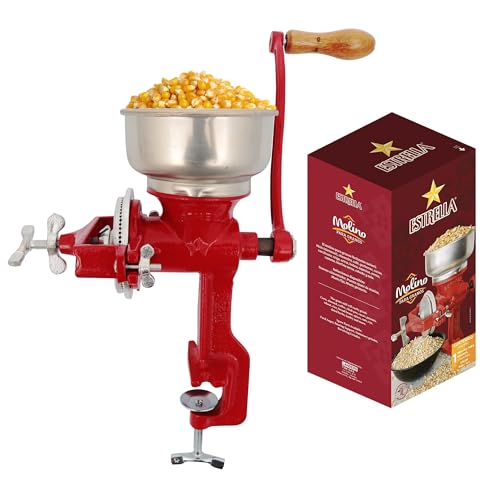
Best for Masa and Tortillas – Estrella Manual Corn Grinder
This Estrella manual corn grinder is designed around traditional Mexican and Latin American cooking. Its hand-crank cast iron construction and adjustable settings make it useful for corn, nixtamal, chickpeas, wheat, rice, coffee beans, spices, masa, tortillas, tamales, and similar homemade recipes.
Best For: Cooks seeking a traditional molino for masa, tortillas, tamales, pupusas, arepas, and fresh ingredient preparation.
Pros:
- Traditional hand-crank design requires no electricity.
- Cast iron construction is intended for dependable long-term use.
- Clamps to countertops up to 1.5 inches thick.
- Removable parts simplify cleaning and storage.
Cons:
- Manual grinding requires hands-on effort.
- Its countertop clamp limits compatibility to surfaces no thicker than 1.5 inches.
- It is intended for coarse-grain and traditional food preparation rather than high-volume electric milling.
The Estrella is a strong match for buyers who value authentic preparation and control over freshly ground ingredients. It is more focused than a general-purpose electric feed mill, but well suited to traditional kitchen use.
Best High-Speed Option – VEVOR 2100W Electric Grain Mill
For shoppers comparing corn grinders, this VEVOR electric model is designed for fast dry grinding in home kitchens or light lab use. Its 28,000-RPM motor, three stainless-steel blades, adjustable timing, and stated 30-to-300-mesh range make it suited to turning dry corn and other ingredients into powder.
Best For: Fast processing of dry corn, grains, spices, coffee, and other small-batch ingredients.
Pros:
- High-speed 2100W motor can grind dry ingredients in about 30 seconds.
- Adjustable 5-, 15-, and 30-second timer settings and a 30-to-300-mesh fineness range.
- Large 800 g cup, 270-degree shaking design, and three stainless-steel blades support even grinding.
- Simple four-step operation and wipe-clean stainless-steel housing.
Cons:
- Limited to dry materials; it is not intended for wet, oily, or sticky ingredients.
- Requires a 5-to-10-minute rest after up to 5 minutes of continuous work.
- Hard ingredients may need to be cut into smaller pieces first.
This is a practical pick when speed and fine powder are priorities. Its timed controls and relatively large capacity add convenience, but the dry-only limitation makes it less flexible than a mill designed for moist or sticky foods.
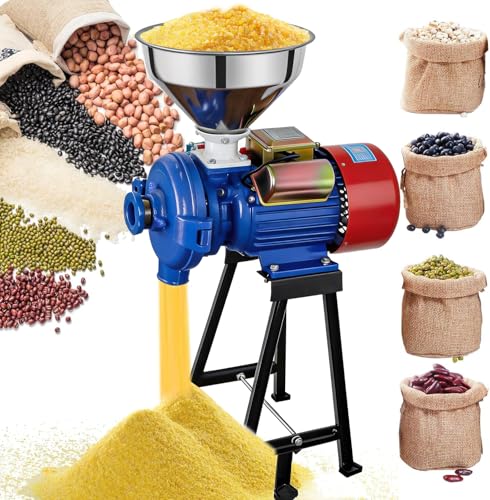
Best for Everyday Use – 3000W Commercial Grain Mill
Among corn grinders, this 3000W electric grain mill stands out for its commercial-style construction and large stainless-steel hopper. It is built for dry corn and other crops, with an adjustable thickness control for producing anything from coarse meal to finer flour or powder.
Best For: High-volume dry grinding of corn, wheat, rice, oats, coffee beans, and similar crops.
Pros:
- 3000W copper motor and 1460-r/min operating speed are suited to demanding dry-grinding work.
- Adjustable thickness knob provides control from coarse to ultra-fine results.
- Large food-safe stainless-steel hopper supports continuous feeding with fewer refills.
- Galvanized body and cast-iron head are designed for heavy-duty durability.
Cons:
- For dry use only; soaked or wet ingredients should not be processed.
- Requires starting the machine before gradually adding grain to reduce the risk of overloading or jams.
- The supplied notes do not specify the hopper capacity or overall dimensions.
This model makes the most sense for users who value power, throughput, and rugged construction over compact details. Follow the recommended feed sequence and use only dry ingredients for the intended performance.
Best Manual Option – VEVOR Hand-Crank Corn Grinder
If you prefer corn grinders that work without electricity, this VEVOR manual mill offers a traditional hand-crank design with a stable table clamp. Its cast-iron construction, adjustable grinding disc, and low hopper make it a useful choice for small batches of corn, grains, spices, coffee beans, and nuts.
Best For: Small-batch grinding when electricity-free operation and low-heat processing are important.
Pros:
- Manual operation avoids electricity and helps prevent heat buildup.
- Adjustable grinding disc lets you change texture, with repeated passes available for finer results.
- Table clamp fits surfaces with a 0.79-to-1.58-inch opening range for more stable grinding.
- Powder-coated cast iron resists rust and wear, while the dust cover helps contain scattered powder.
Cons:
- Manual cranking is slower and more labor-intensive than electric grinding.
- Low hopper is intended for small batches rather than continuous high-volume processing.
- Very fine textures may require multiple grinding passes.
This is a strong fit for hands-on kitchen prep, baking, and home brewing where batch size is modest. The clamp improves stability, while the manual process provides control without relying on an electrical outlet.
Heavy-Duty Corn Grinder – 3000W Adjustable Grain Grinder
For buyers comparing corn grinders for farm use, home milling, or batch processing, this 3000W electric model emphasizes speed and versatility. It can process up to 200 pounds per hour and offers adjustable grinding from coarse meal to fine powder.
Best For: Small livestock farms, home flour milling, brewing, emergency grain preparation, and dry spice or herb grinding.
Pros:
- Powerful 3000W motor is rated to process up to 200 pounds of grain per hour.
- Adjustable settings support coarse crushed corn through fine powder.
- Galvanized cast-iron housing is designed to resist rust and prolonged wear.
- Handles dry corn, wheat, soybeans, rice, barley, and some herbs.
Cons:
- At 47 pounds, it is a substantial machine to move or store.
- Its industrial design may be more capacity than occasional users need.
- The listed dimensions make a dedicated operating area advisable.
This is the strongest high-throughput option in the group, especially for users who need both poultry-feed texture and fine flour capability. Its size and weight make it better suited to a permanent farm, workshop, or dedicated milling setup than a compact kitchen.
Commercial Corn Grinder – VEVOR 1500W Pulverizer
This VEVOR model is one of the more flexible corn grinders for buyers who want commercial-style output without stepping up to the highest-powered machine. Its 1500W motor is rated for about 110 pounds per hour, while the precision knob provides a 30–300 mesh fineness range.
Best For: Farms, ranches, homes, and small workspaces processing dry corn, grains, coffee, spices, or herbs.
Pros:
- 1500W motor running at 1400 RPM delivers a stated capacity of about 110 pounds per hour.
- Adjustable 30–300 mesh control supports coarse grinding through fine powder.
- Cast-iron grinding plates and a stainless steel feed port offer durable construction.
- Non-slip shock-absorbing feet and cooling vents support steadier operation.
Cons:
- It is intended for dry materials and is not suitable for wet, oily, or sticky ingredients.
- Its 47.2-pound weight and industrial dimensions limit portability.
- Users need to follow the staged grinding process for the intended results.
Choose this grinder if adjustable texture matters as much as throughput. It offers a useful middle ground between a high-output farm machine and a lighter-duty unit, provided your ingredients are dry and you have room for its large cast-iron body.
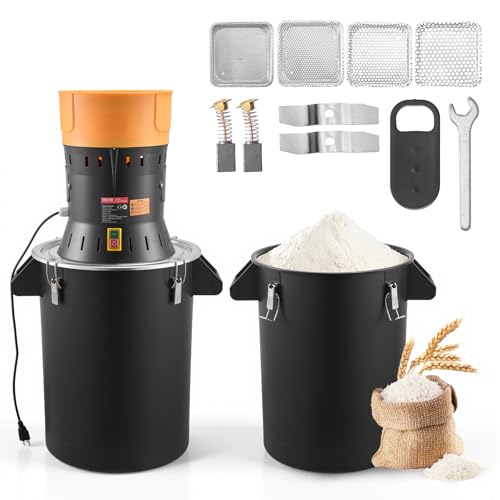
Versatile Corn Grinder – VEVOR 600W Screen-Adjustable Mill
For shoppers seeking corn grinders with interchangeable sizing rather than a single adjustment knob, this VEVOR mill includes screens from 3 to 8 mm. Its 600W motor reaches 15,000 RPM and the detachable hopper is designed to simplify cleaning after dry-grain or spice grinding.
Best For: Users who need selectable feed, flour, or spice textures and want a lighter machine for occasional farm or household use.
Pros:
- Five screen sizes—3, 4, 5, 6, and 8 mm—provide selectable coarseness.
- High-speed 600W motor reaches 15,000 RPM for dry-material grinding.
- Detachable hopper and feed inlet make cleaning more convenient.
- At 18.3 pounds, it is substantially lighter than the other listed models.
Cons:
- The 600W motor is less powerful than the 1500W and 3000W alternatives.
- The listed 220V voltage may require compatibility checking before purchase.
- It is intended for dry ingredients rather than wet, oily, or sticky materials.
This is the most approachable choice for buyers prioritizing interchangeable screens and easier handling. Confirm your electrical setup before ordering, and select it when the intended workload is moderate rather than the highest-volume corn processing.
How We Picked the Best Corn Grinders
We evaluated these Corn Grinders by comparing their power source, motor capacity, grinding adjustability, construction, throughput claims, hopper design, portability, and intended use. The selection includes manual cast-iron mills, household electric grinders, and larger commercial-style machines. Because advertised capacity can vary with corn moisture, grind setting, and operator technique, treat output figures as estimates rather than guarantees.
We also considered practical ownership details: whether a model can handle dry corn reliably, how easy it is to change or clean grinding components, how securely it sits during use, and whether its design suits flour, meal, cracked grain, spices, or animal feed.
Quick Comparison
- Best for maximum control: Manual cast-iron mills let you work without electricity and adjust the texture through repeated passes.
- Best for speed: High-wattage electric models are better for larger batches and frequent feed preparation.
- Best for versatility: Adjustable electric grinders with multiple screens or settings can produce several textures.
- Best for occasional use: A compact manual mill or lower-capacity electric machine may be easier to store and maintain.
- Best for heavy workloads: Look for sturdy housings, stable feet or clamps, protected controls, and a hopper sized for your normal batch.
Key Buying Factors for Corn Grinders
Manual or Electric Operation
Manual mills are quiet, durable, and useful where electricity is unavailable, but they require more effort and usually process smaller quantities. Electric grinders save time and energy, although they need a suitable outlet, ventilation, and careful attention to duty-cycle limits.
Power and Realistic Capacity
Higher wattage can support faster grinding, but it does not automatically indicate better flour or meal. Match the machine to your expected batch size, and avoid feeding corn faster than the manufacturer recommends. For animal feed, throughput may matter more than an especially fine texture.
Grind Adjustment and Screens
Multiple sieves or adjustable settings are valuable if you want to switch between coarse meal, flour, cracked corn, and other textures. Confirm that replacement screens or burr components are available before committing to a specialized model.
Build Quality, Stability, and Safety
Cast iron and stainless steel can provide useful durability, while a clamp, non-slip base, or broad footprint helps prevent movement. Check for guarded blades, secure lids, overload protection, and clear cleaning instructions. Never reach into a powered grinder and always use completely dry, appropriate ingredients.
Who Should Buy Which Corn Grinders?
Choose a manual cast-iron corn grinder if you value reliability, hands-on control, quiet operation, or off-grid use. Pick a mid-powered electric model for routine kitchen batches and occasional feed preparation. A high-wattage commercial-style grinder makes more sense for farms, homesteads, or users processing substantial amounts regularly, provided you have adequate power and storage space.
Before ordering, verify the product’s permitted ingredients, voltage, dimensions, included accessories, and cleaning requirements. The best choice is not necessarily the most powerful grinder—it is the one whose capacity, texture control, and maintenance demands match your actual workload.