Processing a garden harvest or preparing sauce for canning is much easier with the right tomato press. These machines separate skins and seeds while turning whole tomatoes into smooth pulp with less prep and mess.
We selected 10 options ranging from compact manual mills to high-output electric machines, so you can match your equipment to your batch size, available power, and preferred workflow.
Best 10 Tomato Presses for Large Batches Picks for 2026
Large-Batch Electric Pick

- 1-gallon hopper for bulk produce
- 250-watt motor with reverse setting
- Three stainless steel screens included
Best For: Home preservers processing garden harvests or bulk produce
Compact Manual Choice

- Manual operation needs no electricity
- Suction base helps hold it steady
- Strains without peeling or coring
Best For: Smaller kitchens and hands-on sauce or salsa batches
Versatile Hand-Crank Option

- Three milling discs for texture control
- Dual hooks improve bowl stability
- Dishwasher-safe stainless steel design
Best For: Multi-purpose manual milling and small-to-medium sauce batches
High-Volume Workhorse

- Processes up to 309 pounds per hour
- 450-watt induction motor for continuous use
- Cast-iron and stainless steel construction
Best For: Serious home preservers handling very large harvests
Large-Batch Manual Pick
Weston Stainless Steel Tomato Strainer
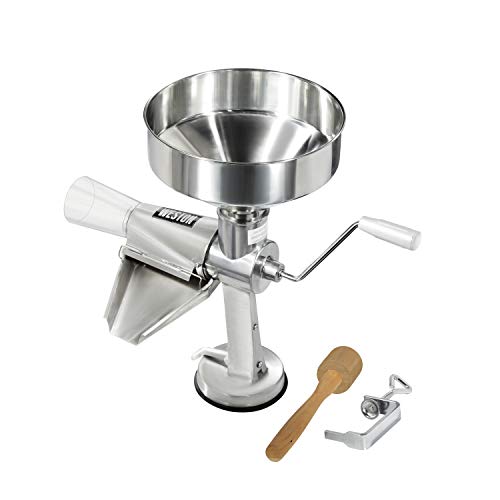
- One-gallon hopper for fewer refills
- Manual dual-mount design
- Includes 1.5mm screen and stomper
Best For: Home cooks processing sizable batches without electricity
High-Volume Electric Pick

- 370W motor for less manual effort
- Stated capacity of up to 200 pounds per hour
- Tool-free disassembly for rinsing
Best For: Bulk canning and frequent harvest-season processing
Versatile Small-Batch Alternative
Stainless Steel Rotary Food Mill

- Three milling discs for varied textures
- Silicone-covered ergonomic handles
- Can also mash, strain, and steam
Best For: Manual, multipurpose kitchen processing
Best Manual Batch Pick
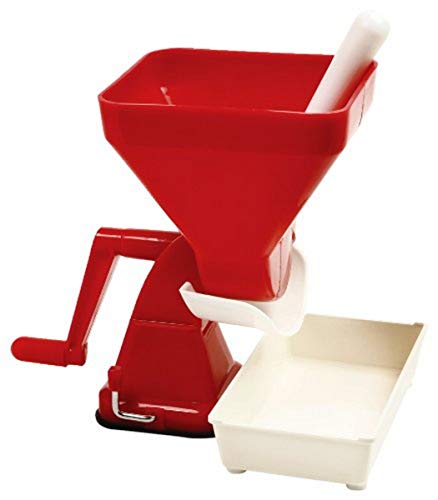
- 2.25-quart hopper for larger processing runs
- Stainless mesh separates seeds and skins
- Suction base supports stable manual cranking
Best For: Home canning and electricity-free sauce making
Best Commercial-Style Throughput
VBENLEM Electric Tomato Strainer
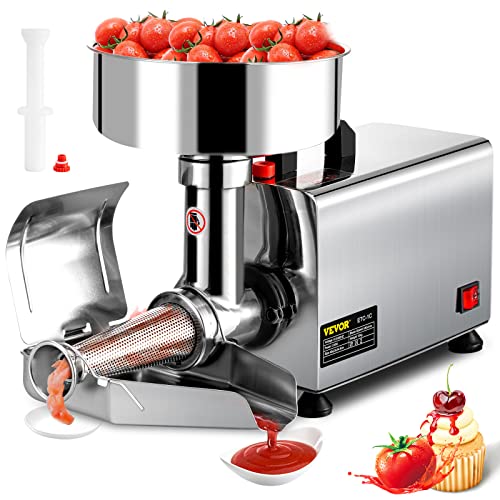
- 370-watt motor for powered milling
- 9-inch funnel supports steady feeding
- 304 stainless food-contact components
Best For: High-volume sauce and tomato processing
Best Multi-Use Kitchen Option
AIRMSEN Meat Grinder & Sauce Press

- Tomato strainer plus meat and sausage functions
- Three grinding plates for varied textures
- Reverse function helps address jams
Best For: Versatile home meal prep and sauce making
Large-Batch Electric Pick – Weston Deluxe Tomato Strainer
For shoppers comparing tomato presses for large batches, the Weston Deluxe stands out with a 1-gallon hopper and 250-watt motor. Its electric operation, reverse setting, and included screens make it suited to processing tomatoes, berries, vegetables, and other soft produce for sauces, purees, jellies, and salsa.
Best For: Home preservers processing garden harvests or bulk produce.
Pros:
- 1-gallon hopper supports larger processing runs.
- Two-speed motor includes reverse to help prevent jams.
- Three stainless steel screens support fine, medium, and chunky results.
- Stomper helps guide food safely into the hopper.
Cons:
- Requires access to a 120-volt power source.
- Its plastic and stainless-steel construction may be less heavy-duty than cast-iron alternatives.
The Weston offers a practical balance of capacity and versatility for frequent home canning. Its 4-liter capacity and interchangeable screens are useful when one machine needs to handle several recipes.
Compact Manual Choice – Suction-Mount Tomato Strainer
This manual tomato strainer is a straightforward option for cooks who want tomato presses for large batches without using electricity. It separates skins and seeds while juice moves into the tray, and its suction-cup base is designed to keep the mill steady during use.
Best For: Smaller kitchens and hands-on batches of sauce, salsa, or puree.
Pros:
- Manual design does not require an electrical outlet.
- Suction mount helps stabilize the food mill.
- Separates skins and seeds without peeling, deseeding, or coring first.
- Includes a stainless steel pusher.
Cons:
- Manual cranking can be less convenient for very large harvests.
- Notes do not specify interchangeable screens or a large hopper capacity.
- Plastic construction may not feel as substantial as stainless-steel models.
This strainer keeps the process simple and compact, making it useful when storage space or electrical access is limited. For especially large volumes, its manual operation may require more time and effort than an electric press.
Versatile Hand-Crank Option – Stainless Steel Food Mill
For cooks seeking tomato presses for large batches in a manual format, this stainless steel food mill offers three milling discs and a dual-hook design for bowl stability. It can mill tomatoes, fruits, and vegetables while also handling mashed potatoes, jams, and other preparations.
Best For: Cooks who want one manual mill for sauces, purees, and multiple foods.
Pros:
- Food-grade stainless steel construction with a mirror-polished finish.
- Three milling discs provide different textures.
- Dual hooks and a silicone-covered crank support steadier operation.
- Dishwasher-safe components simplify cleanup.
Cons:
- Manual operation may be slower and more tiring for very large quantities.
- It must be positioned over a suitable bowl or pan rather than processing into a dedicated hopper.
- The notes do not provide a batch-capacity or hourly-throughput rating.
This mill is a flexible choice when texture control and easy cleaning matter more than powered speed. Its accessories, including a funnel and multifunctional spoon, add convenience for broader kitchen use.
High-Volume Workhorse – Reber N.3 Electric Strainer
Among tomato presses for large batches, the Reber N.3 is built for sustained processing. Its 450-watt induction motor is rated for up to 309 pounds of tomatoes per hour, while the cast-iron body, stainless steel components, and oil-bath gearbox emphasize long-term heavy use.
Best For: Serious home preservers handling very large tomato harvests.
Pros:
- Continuous motor operation is rated up to 309 pounds per hour.
- Cast-iron body and stainless steel filter cone, hopper, and tray support durability.
- Oil-bath gearbox is described as maintenance-free and designed for long life.
- Compatible optional attachments expand its kitchen uses.
Cons:
- At 21 pounds, it is substantially heavier than compact manual mills.
- Hand-wash-only care requires more cleanup attention.
- Optional attachments are not included with the base machine.
The Reber is the strongest fit here for unusually large harvests or repeated preserving sessions. Its high throughput and durable materials come with greater weight and a more involved cleaning routine.
Large-Batch Manual Pick – Weston Stainless Steel Tomato Strainer
For shoppers comparing tomato presses for large batches, the Weston stands out with a one-gallon hopper and a manual design that does not require electricity. Its stainless steel construction, dual mounting options, and included 1.5mm screen make it practical for sauces, purees, jams, and preserves.
Best For: Home cooks who want a manually operated press for sizable batches and flexible countertop or garden-table use.
Pros:
- One-gallon hopper helps process more produce between refills.
- Dual suction-cup and C-clamp mounting system suits various flat surfaces.
- Separates skins and seeds without peeling or coring first.
- Includes a stomper, splash guard, chute, and 1.5mm multipurpose screen.
Cons:
- Manual operation requires turning the handle throughout processing.
- Additional screens are sold separately.
The Weston is a strong choice when you want large-batch capacity without adding a motor. It is especially appealing for users who value versatile mounting and straightforward sauce processing.
High-Volume Electric Pick – VEVOR 370W Tomato Strainer
Among tomato presses for large batches, the VEVOR is designed for speed and reduced manual effort. Its 370W motor, large hopper, and stated processing capacity of up to 200 pounds per hour make it a compelling option for harvest-season sauce making and bulk canning.
Best For: High-volume processing when faster, motorized straining is more important than a compact countertop footprint.
Pros:
- 370W motor reduces the effort required for large-batch sauce making.
- Stainless steel filter separates peels and seeds in a single pass.
- Large hopper helps limit frequent refilling.
- Core components disassemble without tools for easier rinsing.
Cons:
- At 21.7 pounds, it is heavier than a simple manual food mill.
- Tomatoes should be cut into small pieces to help reduce clogging.
- Its 19.29-by-9.06-by-13.58-inch size requires dedicated storage space.
The VEVOR is the most productivity-focused option here, particularly for repeated harvest processing. Its electric motor and high stated throughput should appeal to serious canners, provided you have room for the larger machine and prepare produce appropriately.
Versatile Small-Batch Alternative – Stainless Steel Rotary Food Mill
If you are evaluating tomato presses for large batches but prefer a compact manual tool, this rotary food mill offers versatility rather than powered throughput. It includes three milling discs for different textures and can also handle mashed potatoes, jams, fruits, and vegetables.
Best For: Cooks who want a manual food mill for varied kitchen tasks and occasional tomato sauce preparation.
Pros:
- Three milling discs provide different pore sizes and textures.
- Stainless steel body is described as durable, food grade, and dishwasher safe.
- Dual hooks and a silicone-covered handle help stabilize the mill over a bowl.
- Included spoon can press food and scrape the filter surface.
Cons:
- It is a manual mill rather than an electric, high-throughput tomato press.
- Its 1.32 kg weight and bowl-mounted design indicate a smaller-scale format than hopper-style presses.
This food mill is best viewed as a multifunctional kitchen tool, not a dedicated harvest-processing machine. The interchangeable discs and comfortable rotary design make it useful when flexibility matters more than maximum batch speed.
Best Manual Batch Pick – Norpro Jumbo Tomato Strainer
For shoppers comparing tomato presses for large batches, the Norpro Manual Jumbo Tomato Strainer offers a straightforward, electricity-free way to process tomatoes, apples, and other soft produce. Its 2.25-quart hopper and suction base are practical for repeated countertop use.
Best For: Home canning, marinara, salsa, puree, paste, juice, and applesauce preparation.
Pros:
- Large 2.25-quart hopper helps process substantial quantities between refills.
- Stainless steel mesh separates seeds, skins, and stems automatically.
- Suction base helps keep the press stable on smooth countertops.
- Includes a receiving tray, pestle, instructions, and starter recipes.
Cons:
- Manual cranking requires more hands-on effort than an electric press.
- The suction base is intended for smooth surfaces.
- Cleanup still requires disassembly, even though the unit comes apart quickly.
This is a sensible choice when you want generous capacity without adding a motor. It is especially appealing for occasional or seasonal home processing where portability and simple operation matter.
Best Commercial-Style Throughput – VBENLEM Electric Tomato Strainer
Among tomato presses for large batches, the VBENLEM electric strainer is designed for higher-volume processing with a 370-watt motor, large feeding funnel, and stainless steel food-contact components. Its electric operation can reduce the manual work involved in milling tomatoes and sauces.
Best For: High-volume tomato milling and preparing ketchup, fruit sauces, jams, and similar mixtures.
Pros:
- 370-watt pure copper motor is built for powered processing.
- Manufactured with stainless steel, including 304 stainless steel food-contact parts.
- 9-inch funnel supports generous feeding of produce.
- Adjustable trough and brace help direct sauce and reduce splashing.
Cons:
- At 22 pounds, it is considerably heavier than a manual countertop press.
- Requires a 110V power supply.
- The notes emphasize sauce and milling use rather than a broad range of food-processing attachments.
The VBENLEM is the strongest fit here for users prioritizing powered, repeated processing over compact storage. Its heavier construction and adjustable discharge setup make it better suited to a dedicated prep area than occasional cabinet use.
Best Multi-Use Kitchen Option – AIRMSEN Meat Grinder & Sauce Press
If you want tomato presses for large batches but also need other kitchen functions, the AIRMSEN combines tomato straining with meat grinding, sausage making, and kibbeh preparation. Its electric design and triple spiral extrusion system are aimed at efficient home-kitchen processing.
Best For: Home cooks who want one appliance for tomato sauce, ground meat, sausages, and kibbeh.
Pros:
- Combines tomato pressing with three additional food-preparation functions.
- Includes three grinding plates for different textures.
- Reverse function helps clear jams during operation.
- Non-slip feet and a safety-lock knob support stable assembly and use.
Cons:
- Tomato pressing is one function within a multi-purpose appliance, not its sole focus.
- Parts are not dishwasher safe and require hand washing.
- Supplied details list 300 watts, so its tomato throughput should not be assumed to match dedicated commercial machines.
The AIRMSEN makes the most sense when versatility matters as much as tomato processing. It can streamline several kitchen tasks, but buyers seeking a dedicated high-volume tomato machine may prefer a purpose-built press.
How We Picked the Best Tomato Presses for Large Batches
We focused on the features that matter when processing more than a few pounds at a time: motor power or manual leverage, hopper and output capacity, construction materials, stability, cleaning requirements, and the ability to handle repeated batches. The lineup includes electric tomato strainers for speed, manual models for simpler operation, and food mills with interchangeable discs for added versatility.
Product specifications can vary by seller and configuration, so confirm current dimensions, included screens, voltage, rated capacity, and replacement-part availability before ordering.
Quick Comparison
- Electric models: Best for frequent sauce making and large harvests, with less hand effort and faster processing.
- Manual strainers: Useful when portability, lower cost, or no access to an outlet matters more than maximum throughput.
- Food mills: A flexible choice for tomatoes, potatoes, jams, and other soft foods, though they may require more hands-on work.
- Commercial-style machines: Worth considering for very large batches when a sturdy frame, larger hopper, and continuous operation are priorities.
Key Buying Factors for Tomato Presses for Large Batches
Capacity and Throughput
Look beyond the advertised hourly rating. A large hopper reduces loading time, while real-world output depends on tomato variety, ripeness, cutting size, screen selection, and how often pulp or skins need clearing. For canning days, choose a machine with enough capacity to avoid constant pauses.
Motor Power and Duty Cycle
Electric power can reduce fatigue, but wattage alone does not determine performance. Check whether the unit is intended for intermittent household use or longer processing sessions. Overloading a smaller machine can slow production and increase wear.
Materials, Stability, and Safety
Stainless steel components are generally easier to maintain and better suited to repeated food processing. A wide base, clamp, or non-slip feet help keep the press steady. Confirm that food-contact parts are easy to remove and that the electrical controls and housing are protected from splashes.
Cleanup and Replacement Parts
Large batches create substantial pulp and waste, so screens, funnels, augers, and collection trays should disassemble without unnecessary effort. Before buying, check whether additional screens, replacement gaskets, and augers are available.
Who Should Buy Which Tomato Presses for Large Batches?
Choose an electric strainer if you process garden tomatoes regularly, want to minimize manual cranking, or need to prepare sauce efficiently for freezing or canning. Models with higher rated capacities make the most sense for substantial harvests.
Choose a manual strainer or food mill if you process occasional batches, value straightforward storage, or need a tool that can also handle potatoes, jams, and other soft foods. These options avoid motor noise and electrical requirements but demand more effort.
Choose a commercial-grade electric machine if you routinely process very large quantities and have suitable counter space and power. Prioritize durable construction, stable mounting, a practical duty cycle, and accessible replacement parts over the highest advertised speed alone.