Making sauce, puree, and passata for canning is much easier when a tomato press separates skins and seeds before the cooking stage. The right machine can reduce prep time, limit waste, and produce a smoother, more consistent texture.
This roundup compares 10 tomato presses for canning, including clamp-on manual models, countertop electric strainers, and commercial-style machines. Use the guide below to match capacity, cleanup, durability, and budget to your preserving routine.
Best 10 Tomato Presses for Canning Picks for 2026
Best Clamp-Mount Pick

- 1.3mm tomato screen included
- Secure clamp fits varied countertops
- Optional motor and screens available
Best For: Multipurpose small-batch sauce and puree making
Best Traditional Strainer
- 3-quart/95-ounce listed capacity
- Fine mesh screen and spiral included
- Optional berry, pumpkin, and salsa screens
Best For: Classic manual fruit and vegetable straining
Best High-Volume Electric Pick

- Rated for up to 330 pounds per hour
- 1/4 HP motor with cooling fan
- 220-volt corded electric design
Best For: Rapid processing of large tomato batches
Best Large-Hopper Manual Pick
- One-gallon stainless steel hopper
- Suction-cup and C-clamp mounting
- 1.5mm screen and stomper included
Best For: Larger manual batches in flexible locations
Best Manual Pick

- Manual design needs no electricity
- Separates skins and seeds
- Includes stainless steel pusher
Best For: Small-batch sauces, puree, and salsa
Best for Large Batches
Weston Deluxe Electric Tomato Strainer

- 250-watt motor with reverse speed
- One-gallon hopper for batch processing
- Three stainless steel screens included
Best For: Canning and preserving large harvests
Best Commercial-Style Power
450W Stainless Steel Tomato Press

- 450-watt motor for bulk processing
- Stainless steel construction
- Large funnel and adjustable trough
Best For: High-volume electric processing
High-Capacity Pick
Automatic Electric Tomato Strainer

- Separates skins and seeds automatically
- Processes up to 330 pounds per hour
- 304 stainless steel with 5-year warranty
Best For: Large home-canning batches, farms, and commercial kitchens
Commercial Batch Option

- Stainless steel build with stable four-point base
- Designed for sauces, purees, and jams
- Disassembles for easier cleaning
Best For: Recurring home or small-commercial batch processing
Quiet Processing Choice
- 370W pure copper motor
- 9-inch funnel and adjustable discharge trough
- 304 stainless steel food-contact parts
Best For: Home canners making sauce and puree with an electric strainer
Best Clamp-Mount Pick – Johnny Apple Sauce Maker
For shoppers comparing tomato presses for canning, the Johnny Apple Sauce Maker is a versatile manual option that separates skins and seeds while producing sauces, purees, juices, and more. Its clamp fits countertops from 3/4 to 2-1/8 inches thick.
Best For: Home canners who want a multipurpose hand-crank strainer with a secure countertop mount.
Pros:
- Includes a 1.3mm apple/tomato screen, standard spiral, and instructions.
- Handles tomatoes, fruits, vegetables, jams, soups, baby foods, and purees.
- Cast aluminum body, stainless steel screen, and BPA-free plastic components.
- Optional electric motor and additional screens are available separately.
Cons:
- Manual operation requires turning the hand crank.
- Optional motor and specialty screens add separate costs.
This is a practical choice when flexibility matters more than automated throughput. The broad range of compatible produce and sturdy clamp make it useful for recurring small-batch sauce and canning preparation.
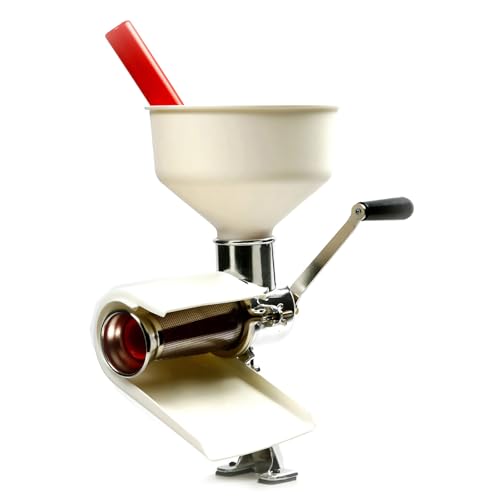
Best Traditional Strainer – Norpro 1951 Sauce Master
The Norpro 1951 is a straightforward choice among tomato presses for canning, using a hand-operated process to force produce through a chrome-plated steel screen while separating juice and pulp in one operation.
Best For: Home cooks seeking a classic manual strainer for vegetables, fruits, sauces, and purees.
Pros:
- Handles vegetables, fruits, and purees with automatic juice-and-pulp separation.
- Includes a standard fine mesh screen, standard spiral, recipe, and instruction booklet.
- Has a listed 3-quart/95-ounce capacity.
- Additional berry, pumpkin, and salsa screens are available separately.
Cons:
- Specialty screens are not included.
- Manual straining is less convenient than an electric model for extended batches.
The Sauce Master keeps the setup simple and includes the basic components needed to begin straining. It is best suited to cooks who prefer manual control and may expand its capabilities with optional screens.
Best High-Volume Electric Pick – OMRA Spremy Electric Strainer
For large tomato-processing jobs, the OMRA Spremy is an electric option among tomato presses for canning. Its 1/4 HP motor automatically separates puree from skins and seeds and is rated for production of up to 330 pounds of tomatoes per hour.
Best For: High-volume tomato processing where powered operation and rapid throughput are priorities.
Pros:
- Processes fresh or cooked tomatoes and automatically separates skins and seeds.
- Rated for up to 330 pounds, or 150 kilograms, of tomatoes per hour.
- Includes a die-cast metal housing, stainless steel hopper, and food-grade nylon auger.
- 110 RPM masticating-style rotation and a cooling-fan-equipped motor.
Cons:
- Requires a corded electric connection.
- Listed voltage is 220 volts, so electrical compatibility should be checked.
- Its high-throughput design may be more than needed for occasional small batches.
The OMRA stands out for speed and automation rather than compact manual simplicity. Verify the 220-volt requirement before buying, especially if your canning setup is designed for standard household outlets.
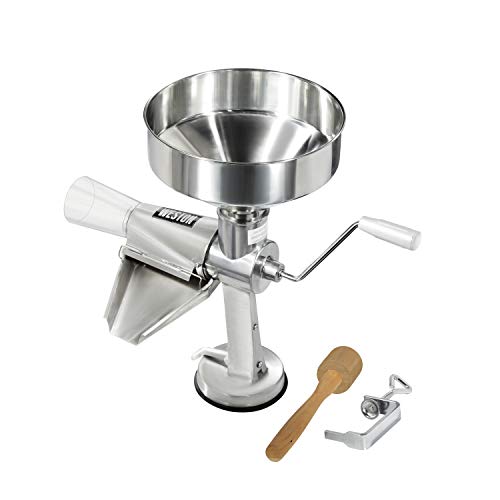
Best Large-Hopper Manual Pick – Weston Metal Tomato Strainer
The Weston Metal Tomato Strainer is a useful contender among tomato presses for canning when you want a larger hopper and flexible placement. Its one-gallon hopper, dual-mount system, and 1.5mm screen support batch processing without peeling or coring tomatoes first.
Best For: Home canners processing larger manual batches in the kitchen, garden, or other work areas.
Pros:
- One-gallon stainless steel hopper supports larger batches.
- Dual mount uses a suction-cup base and C-clamp for varied flat surfaces.
- Separates skins and seeds without requiring peeling or coring.
- Includes a stomper, splash guard, chute, and 1.5mm multipurpose screen.
Cons:
- It is manually operated, so processing requires turning the handle.
- Additional specialty screens are sold separately.
The Weston combines a generous hopper with helpful mess-control features and adaptable mounting. It is a strong fit for canners who want manual processing capacity and the option to work away from a permanent kitchen setup.
Best Manual Pick – Suction-Mount Tomato Strainer
If you want tomato presses for canning without relying on electricity, this manual strainer offers a straightforward way to juice and puree tomatoes. Its suction-cup base helps hold it in place while the stainless steel pusher guides produce through the mill.
Best For: Home cooks who want a manual option for tomato juice, puree, homemade salsa, and pasta sauce.
Pros:
- Separates skins and seeds while juice exits through the tray.
- Suction mount helps stabilize the food mill during use.
- Includes a stainless steel pusher and is designed for easy cleaning.
Cons:
- Manual operation requires more hands-on effort than an electric press.
- Plastic construction may be less suited to heavy-duty processing than stainless steel models.
This is a practical choice for smaller batches and cooks who value simple operation, compact dimensions, and no electrical power requirement.
Best for Large Batches – Weston Deluxe Electric Tomato Strainer
For high-volume tomato presses for canning, the Weston Deluxe combines a 250-watt motor with a one-gallon hopper. It is built to process tomatoes and other soft produce efficiently while separating skins and seeds without coring.
Best For: Gardeners and home preservers processing large harvests for sauces, jams, salsa, and canning.
Pros:
- Powerful 250-watt motor includes forward and reverse speeds to help prevent jamming.
- One-gallon hopper supports larger batches.
- Includes 1.5mm, 3mm, and 6mm stainless steel screens for different textures and produce.
- Designed to remove skins and separate seeds without coring.
Cons:
- Requires access to a 120-volt AC power source.
- Larger 14-by-12-by-17-inch footprint may need dedicated counter or storage space.
With multiple screens, reverse operation, and a large hopper, this is the most versatile supplied option for frequent processing and substantial harvests.
Best Commercial-Style Power – 450W Stainless Steel Tomato Press
If you are comparing tomato presses for canning and want higher motor power, this 450-watt electric model is designed for quick processing of larger quantities. Its stainless steel construction, large funnel, and adjustable trough support a streamlined workflow.
Best For: Users seeking a powerful electric tomato mill for bulk tomato, strawberry, or blueberry processing.
Pros:
- 450-watt motor provides strong power for processing larger quantities.
- Stainless steel construction is wear-resistant and suited to repeated use.
- Large funnel accommodates a substantial amount of produce.
- Heat-sink holes support heat dissipation during operation.
Cons:
- Uses a 110V electrical connection, so it is not suitable for off-grid use without compatible power.
- At about 19.49 inches long, it requires more storage space than the manual model.
- The supplied notes do not specify included interchangeable screens.
This model stands out for motor power and stainless steel construction, making it worth considering when throughput is a priority and you have suitable electrical access.
High-Capacity Pick – Automatic Electric Tomato Strainer
If you are comparing tomato presses for canning, the ARINOO ETC-1C-2 stands out for its automatic seed-and-skin separation and high stated throughput. Its 450W copper motor, stainless steel construction, and detachable parts make it suited to large batches of tomato puree, sauce, and other fruit preparations.
Best For: Home canners, farms, restaurants, and commercial kitchens processing large quantities.
Pros:
- Dual-channel design separates seeds and skins without an extra filter.
- Stated processing capacity of up to 330 pounds per hour.
- Food-grade 304 stainless steel construction with a 5-year manufacturer warranty.
- Detachable components and an included push rod support easier cleanup and operation.
Cons:
- At 20.9 pounds, it is not especially lightweight for storage or moving.
- Hand-wash care is required, and the manufacturer recommends cooling after each 15 minutes of continuous use.
The ARINOO is a strong choice when batch capacity and automated straining matter most. Its larger commercial-style footprint and operating-care requirements are worth considering before buying for occasional small batches.
Commercial Batch Option – 50 Kg/H Electric Tomato Press
For shoppers seeking tomato presses for canning with a commercial-oriented design, this electric tomato strainer offers stainless steel construction, stable bases, and straightforward disassembly. It is designed for tomato purees as well as jams and sauces made from several fruits and nuts.
Best For: Home users and small commercial operations that want an electric milling machine for recurring batch processing.
Pros:
- Stainless steel body and four stable bases help minimize vibration.
- Fully enclosed motor and included pestle support safer ingredient guidance.
- Disassemblable, smooth components simplify cleaning and maintenance.
- Stated output ranges from 60 to 120 kilograms of jam per hour.
Cons:
- The listed output range is broad, so actual performance may vary by ingredients and conditions.
- At 26.4 pounds, it is relatively heavy to move between uses.
- The supplied details do not specify motor wattage or a warranty.
This model makes sense for buyers prioritizing a sturdy, cleanable machine and higher-volume processing. Verify the available space and desired throughput, especially if your canning sessions are smaller or infrequent.
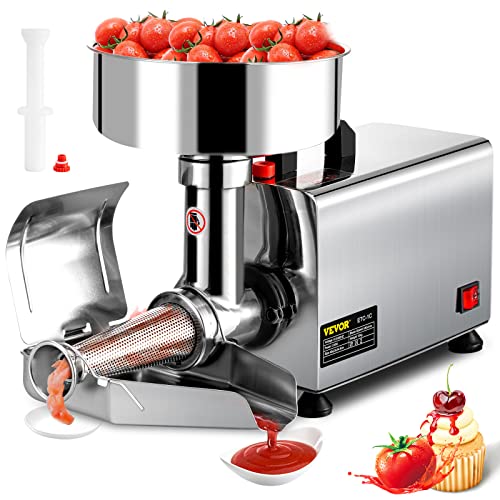
Quiet Processing Choice – VBENLEM 370W Tomato Strainer
Among tomato presses for canning, the VBENLEM 110V model offers a practical balance of motor power, feeding room, and cleanup features. Its 9-inch funnel, adjustable discharge trough, and stated low-noise operation are useful details for processing tomatoes into sauce or puree.
Best For: Canners who want a stainless-steel electric strainer with a wide feeding funnel and adjustable sauce discharge.
Pros:
- 370W pure copper motor is housed in a protective stainless steel casing.
- 9-inch funnel provides room for feeding fruit efficiently.
- Adjustable trough and brace help direct sauce and reduce splashing.
- Food-contact parts are 304 stainless steel, and the machine is designed for disassembly and cleaning.
Cons:
- The listed capacity is 100 kilograms, while the title gives a broader 90–160 kilograms per hour range.
- The product is specified for 110V operation, limiting compatibility in some locations.
- Its 22-pound weight may be cumbersome for frequent storage and setup.
The VBENLEM is a sensible middle-ground option for tomato sauce and puree work, particularly if you value a roomy funnel and adjustable discharge. Check the capacity specifications and available electrical supply before ordering.
How We Picked the Best Tomato Presses for Canning
We focused on the features that matter during real preserving sessions: how efficiently each press separates skins and seeds, its drive system, hopper and output capacity, construction, cleaning requirements, and suitability for repeated batches. The selection includes manual models for occasional use, compact electric machines for home kitchens, and higher-capacity stainless-steel presses for serious gardeners or community-scale processing.
Because listed specifications can vary by seller, confirm current wattage, throughput, included screens, clamp or mounting requirements, and voltage before ordering. A machine’s advertised capacity is also a maximum estimate; soft, ripe tomatoes usually process differently from firm or partially cooked fruit.
Quick Comparison
- Manual presses: Best for smaller batches, lower cost, and users who prefer a simple tool without a motor.
- Compact electric presses: A practical middle ground for frequent home canning, with less hand effort and faster processing.
- Commercial-style electric machines: Better for large harvests, but they require more storage space, careful setup, and thorough cleaning.
- Stainless-steel models: A strong choice when durability, stain resistance, and long-term food-contact use are priorities.
Key Buying Factors for Tomato Presses for Canning
Manual or Electric Operation
Manual presses are quiet, portable, and easy to store, but turning the handle can become tiring during multiple bushels of tomatoes. Electric models reduce physical effort and maintain a steadier feed rate, making them preferable for frequent or large-batch canning.
Capacity and Throughput
Check hopper size and stated processing rate, but treat high throughput claims as a guide rather than a guarantee. A compact press is often sufficient for a few jars, while a larger hopper and stronger motor make sense for garden harvests or repeated batches.
Materials and Stability
Look for sturdy clamps, a stable base, corrosion-resistant components, and food-safe parts. Stainless steel is especially useful for durability and cleanup. Make sure the press fits your counter or worktable and that its outlet can direct pulp into the container you plan to use.
Cleaning and Replacement Parts
Tomato pulp dries quickly, so removable screens and augers are valuable. Confirm that the strainer can be disassembled easily and that replacement screens, gaskets, and other wear parts are available. Never submerge a motor housing unless the manufacturer explicitly allows it.
Screen and Texture Options
A fine screen produces smoother sauce, while a coarser screen may preserve more pulp and process fruit faster. If you also plan to make applesauce, salsa, jam, or other purees, check whether additional screens or compatible attachments are included.
Who Should Buy Which Tomato Presses for Canning?
Choose a manual strainer if you process modest quantities, want the lowest-maintenance option, or only can a few times each season. Choose a compact electric model if you regularly make sauce and want faster preparation without moving up to industrial equipment. Choose a commercial-style press if you handle large harvests, share equipment, or value throughput more than compact storage.
Before buying, estimate your typical harvest, available counter space, power requirements, and cleanup tolerance. For most home preservers, the best Tomato Presses for Canning are not necessarily the fastest models; they are the ones that process a full batch comfortably and clean up without becoming a chore.